
Comparing Karditsa, Trikala, Volos, Ioannina, Keramoti, Messolonghi, Kalamata and Chania for a cycling retirement
For most foreign retirees weighing a permanent move, the bicycle is an afterthought, something to consider once the property, the healthcare, and the paperwork are settled. For a smaller but growing number, it is closer to a condition. Not every place that looks flat on a map rides flat. Not every seafront promenade goes anywhere useful. And a city that works beautifully for cycling in April can turn hostile in a Peloponnesian August or an Epirus January.
Karditsa, Trikala, Volos, Ioannina, Keramoti, Messolonghi, Kalamata and Chania span three very different regions and three very different scales, from a fishing-village-turned-ferry-port of under two thousand people to a regional capital of the size of Chania. What they share is that all eight have, at some point, been singled out, by municipalities, by cycling communities, or simply by geography, as places where a bicycle is a genuine way to live, not a holiday prop.
Flat ground, and where it runs out
Flatness is the first filter, and it separates the eight cleanly into two groups. Trikala is consistently cited as one of the flattest, most cycling-friendly urban centres in the country, and its topography is the main reason the city has built an actual cycling identity rather than simply tolerating bicycles. Karditsa, thirty kilometres south, is built on the same flat Thessalian plain and trades on it just as directly, having branded itself around cycling in a way few towns of its size have attempted.
Volos and Chania share a description that shows up often in cycling literature: both are singled out for the unusually level ground of their urban road networks, a rare trait for a coastal city, most of which climb straight into hills a few streets back from the water. Kalamata belongs in this group too, its flatness reinforced by mild winters that keep the ground rideable year-round rather than just in the dry months.
Messolonghi and Keramoti are flat in a different, more extreme way, because both sit in river deltas rather than on urban plains. Messolonghi borders one of the largest lagoons in the country; Keramoti sits in the delta of the Nestos. Neither has anything resembling a hill for kilometres in any direction, which makes them the easiest of the eight in pure physical terms, even though neither has anything like a Trikala-sized cycling culture behind it.
Ioannina is the outlier. Its centre, particularly around the lake and the old town, is genuinely manageable by bicycle, but the city sits in a mountainous region, and anyone who wants to ride beyond the immediate centre meets the topography of Epirus fairly quickly. Flat where it matters most, for day-to-day errands, but not a city where cycling extends casually into the countryside the way it does from Karditsa or Messolonghi.
Where the infrastructure is real, and where it isn’t
Flat ground helps, but it is not the same as a city that has actually built for cyclists, and here the gap between the eight widens.
Trikala has the strongest claim of any city on this list, with several dedicated cycle paths through the centre, municipally provided bicycles at fixed points around town, and a resident cycling culture built up over years, anchored by an active local club that organises both sporting events and everyday social riding. Karditsa is close behind, with a purpose-built network of urban and suburban cycle paths running well into double digits in length, and free municipal bicycles for getting around the centre, including a well-used route out to the woods southwest of town.
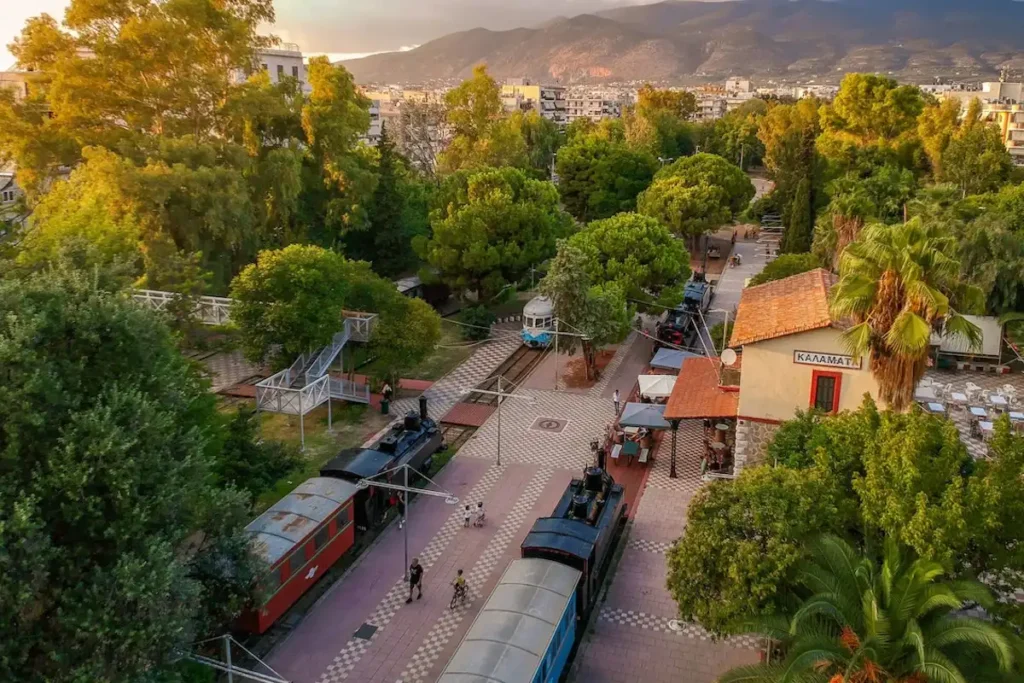
Kalamata‘s infrastructure is newer but expanding quickly. A dedicated path now runs along a long stretch of the seafront promenade, and the city converted its old railway line into a green corridor (the Railway Park) that doubles as a car-free cycling route through the centre. Local reporting has described a sharp rise in everyday bicycle use in Kalamata in recent years, with demand for bicycles and e-bikes climbing well beyond ordinary tourist interest.
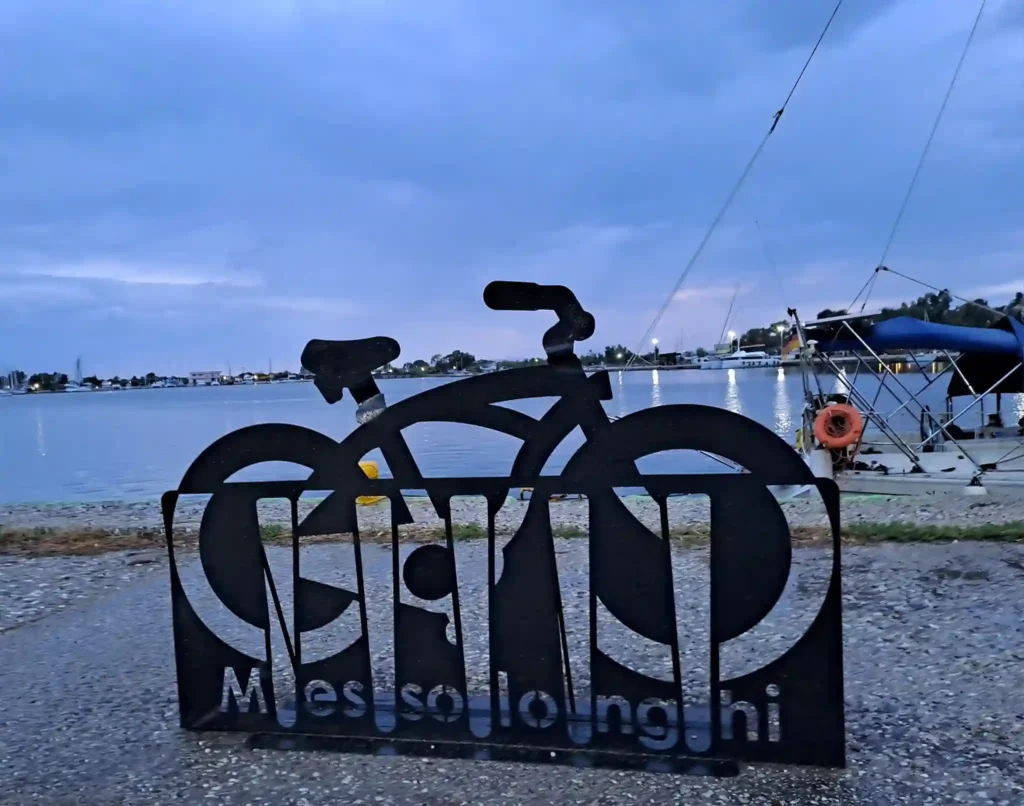
Messolonghi’s infrastructure is the newest of the eight and still being finished. A waterfront cycle path now runs out toward Tourlida and the lagoon’s edge, largely car-free, threading past the salt pans and the Salt Museum. It’s genuinely distinctive riding, even if the network itself is thin compared with Trikala or Karditsa.
Chania, Volos and Keramoti are different again: none has built a dedicated network to compare with Trikala or Kalamata, but all three offer favourable natural conditions (flat terrain, coastal roads, low-rise development) that make cycling workable without much purpose-built infrastructure. In Chania this holds mainly along the coastal roads and promenade out toward the western beaches; the cobbled lanes of the Old Town itself are better walked than ridden. Ioannina sits closer to Trikala in ambition but with a smaller network, concentrated around the lake and centre rather than extending through the wider city.
The riding season
The riding season is where the north-to-south divide among the eight becomes unavoidable. Kalamata and Chania offer the longest riding season by a clear margin. Mild Mediterranean winters mean the bicycle rarely needs to come off the road, and summer heat, while real, is manageable with an early start or a late-afternoon ride.
Volos sits in between: warm enough for most of the year, but noticeably wetter than the southern cities, with rain a more regular disruption to a riding routine than in Kalamata or Chania.
Karditsa and Trikala, on the flat Thessalian plain, run to genuine four-season riding: hot, dusty summers and colder, wetter winters that will occasionally keep a rider indoors, but nothing like the disruption further north.
Ioannina is the wettest of the eight and the coldest in winter, with a distinctly northern, mountain climate that can turn a January ride into a short and damp affair rather than a daily habit. This is the trade-off that comes with its lake-and-mountain setting: flat where it counts, but rideable on fewer days of the year than anywhere else on this list.
Messolonghi and Keramoti share a milder profile than Ioannina but bring their own complication: wind. Both sit exposed on open, low-lying coastal and lagoon terrain, and the same flatness that makes them easy to pedal also gives the wind nothing to break against. A calm morning on the Tourlida path can turn into hard work by afternoon, and Keramoti’s position on the open delta carries the same exposure.
How far the city actually goes
A cycling life is not only about the city centre. It is about what opens up once the centre is behind you, and this is where the smaller places on this list earn their spot.
Keramoti is the clearest example. As a town of well under two thousand people, it will never offer Trikala’s density of cafés, shops or cycling clubs. The pine forest along its beach only runs for a short stretch, so it isn’t the draw itself. The real range is inland, where an extensive network of mud tracks fans out close to the Nestos delta, open for kilometres of riding once the town is behind you. For a rider who wants distance and open, unpaved terrain over urban infrastructure, Keramoti’s smallness is close to the entire point.
Messolonghi works the same way. Its lagoon and salt-flat routes extend well past what the town’s modest size would suggest, into a national park landscape used regularly by birdwatchers as well as cyclists, a genuinely different kind of ride from anything the larger cities on this list offer.
Karditsa’s short, well-used route out to the woodland southwest of town shows the same principle at a smaller scale: a compact centre with an easy, worthwhile ride built directly into its layout. Kalamata and Trikala, by contrast, offer range through connection rather than open landscape: from Trikala, cyclists can string together routes toward Karditsa and the lake at Plastira; from Kalamata, the coast road toward Messinia’s beaches and villages extends the seafront path considerably.
Volos and Chania both benefit from spectacular surrounding geography (Pelion above Volos, the White Mountains and coastline around Chania), but in both cases the terrain shifts from easy riding to serious climbing fairly quickly once the flat coastal strip ends, which matters for anyone thinking of cycling, rather than driving, into the surrounding countryside.
Sharing the road
None of the eight has solved the problem of sharing the road with drivers completely, and it is worth treating with more caution than promotional material usually allows.
Even in Trikala, held up nationally as the model, published research into resident attitudes has found real concerns about cycle lane safety and gaps in the network, a useful reminder that “known for cycling” and “solved for cycling” are not quite the same claim. Kalamata’s newer infrastructure has a similar character: strong along the seafront, thinner and more mixed with traffic away from it.
There’s a counterintuitive risk on the quietest roads in this group, and it’s worth stating plainly rather than leaving implied. Keramoti and Messolonghi have so little traffic that the few drivers who do use the semi-high-speed asphalt roads tend to treat them as open road, not a shared one. Speed limits in rural areas are widely and routinely ignored, and a nearly empty road can be more dangerous to a cyclist than a busy one, precisely because a driver isn’t expecting to meet anyone. The same caution applies to the connecting roads out of Trikala, Karditsa and Kalamata once a route leaves the built-up centre: low traffic volume is not the same as safety, and a rider should never read a quiet road as a slow one.
Chania and Volos rely more on the general calm of flat, low-traffic streets than on dedicated lanes, which works well in the quieter centre and less well on busier connecting roads.
What kind of life this builds
Line the eight up by what kind of daily life they support on two wheels, and a rough shape emerges.
Trikala and Karditsa offer the most complete cycling life of the group: built infrastructure, an established culture, flat terrain, and enough scale to combine errands, socialising and recreational riding without needing a car at all. Kalamata is closing that gap quickly, adding genuine infrastructure to an already flat, increasingly cycling-friendly city, with the added benefit of the longest comfortable riding season among the eight.
Chania and Volos suit a rider who wants a bicycle as one part of a fuller city life rather than the organising principle of it: good enough terrain and conditions to make cycling the easy default for errands, without the dedicated culture or network of the Thessalian cities.
Ioannina is the city where cycling works best as a local, in-town habit rather than a wider lifestyle, held back less by ambition than by its climate and geography.
Messolonghi and Keramoti are the two that reward a very specific kind of retiree: someone who wants the ride itself (long, flat, open, close to nature) more than they want cafés, bicycle shops or a cycling club to belong to. Neither will ever compete with Trikala on infrastructure, and neither is trying to.
Weighed as a whole, Trikala is the strongest overall pick for a cycling-centred retirement: real infrastructure, an established culture, four-season riding, and enough connecting routes to make the bicycle a genuine substitute for a car rather than a fair-weather hobby. Karditsa earns its place just behind it for the same reasons at a smaller, simpler scale. Kalamata is the one to watch, its climate advantage alone gives it more comfortable riding days than anywhere else on this list, and its infrastructure is catching up quickly enough that the gap may not hold for long. Chania and Volos suit a rider who wants a bicycle folded into a fuller city life rather than built around one, Messolonghi and Keramoti reward someone who wants the open road itself, and Ioannina, for all its lakeside charm, remains the city where cycling stays a local habit rather than a way of life.
***