Proof of Address: What Counts and Where to Start
For many foreigners retiring in Greece, Proof of Address (Αποδεικτικό Κατοικίας) quickly becomes one of the most confusing administrative requirements. Banks ask for it to open an account, mobile providers request it before issuing a SIM card, and public services may require it for registration or correspondence. Newcomers often face an obvious paradox: how can you prove where you live if you cannot obtain utility services without already proving it? Part of the confusion also comes from a related but separate document, the Certificate of Permanent Residence (Βεβαίωση Μόνιμης Κατοικίας), which serves a different purpose at a later stage of settlement and is addressed later in this piece.
What Counts as Proof of Address
Proof of Address is not a single, standardized document issued automatically to everyone. Different authorities accept different forms of evidence depending on the purpose and the stage of settlement. Greek authorities and private companies are generally concerned with traceability rather than ownership; they want to know where you can officially be reached. Commonly accepted forms include a registered lease contract, a property ownership deed, a recent utility bill, or an official certificate issued by a municipality, and despite common belief, a utility bill is not always the first or only acceptable option. Initial documents often pave the way toward more formal ones later.
When Proof of Address Is Required
Proof of Address is typically requested when opening a Greek bank account, obtaining a mobile or internet subscription, registering with public services, applying for certain residence permits, or accessing tax and healthcare systems. Banks and telecom providers are usually the earliest to ask, while public authorities may accept alternative documentation during the first months of residence.
Obtaining an AFM Without an Address
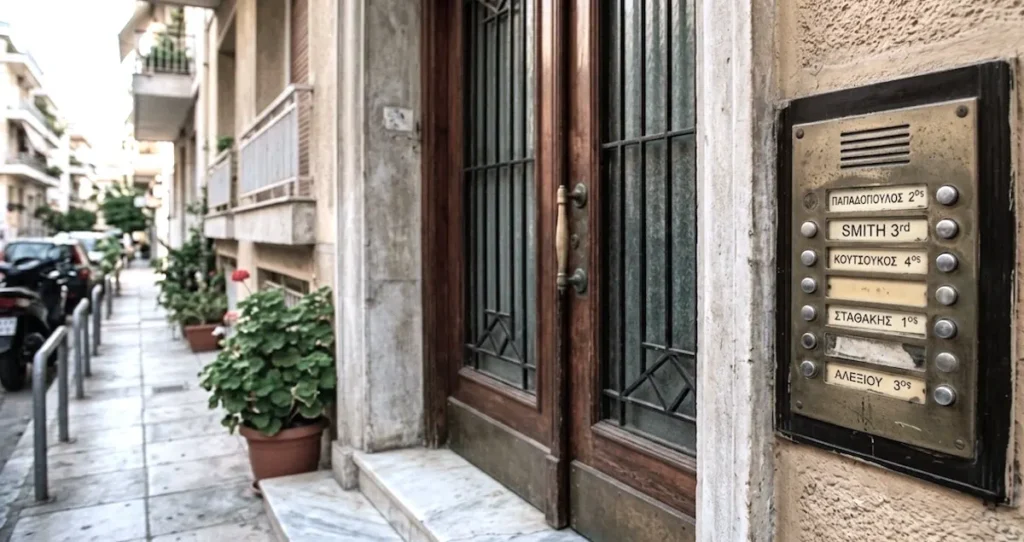
Before a lease can be registered anywhere, you need an AFM. This creates the paradox at the heart of the process: registering a lease on AADE requires an AFM, but obtaining an AFM traditionally requires proof of address. For newcomers who have not yet signed a lease or acquired property, filoxenia is what closes this gap. A Greek resident, often a family member, friend, or short-term host, agrees to declare that you are staying at their primary residence. The address must be a genuine home where the host could actually receive correspondence, not a mailbox or an address set up only for paperwork.
The host logs into Gov.gr with their own Taxisnet credentials and issues a Solemn Declaration (Υπεύθυνη Δήλωση) stating they are hosting you at their primary residence for the purpose of obtaining an AFM, including your full name, father’s name, nationality and passport number. The declaration is generated with a verification code and QR code confirming its authenticity, and no certification from a KEP office or notary is needed; the host simply sends you the electronic document. KEP Service Centres (Κέντρο Εξυπηρέτησης Πολιτών) are often instrumental in guiding residents toward the appropriate solution for their specific situation, including cases where a municipal certificate of residence or a sworn declaration may temporarily substitute for bills, particularly for retirees staying with family or friends.
A frequent concern is whether the host faces any tax consequences for this. The answer depends on distinguishing filoxenia from a separate arrangement called dorean parachorisi. Filoxenia means the host continues living in the property and simply declares that someone else is also staying there; it creates no rental income, does not trigger the 3% deemed-rental-income rules, and does not affect the host’s ENFIA property tax. Dorean parachorisi, by contrast, applies when an owner grants someone exclusive use of an entire separate property without rent. That arrangement is only exempt from imputed rental income taxation between parents and children for properties up to 200 square metres, and does not extend to siblings, spouses, friends or other relatives; outside those exempt cases, the owner can be taxed on deemed rental income at 3% of the property’s objective value. Since filoxenia is a fundamentally different arrangement, hosts have no tax exposure from providing this kind of declaration.
From AFM to a Registered Lease
With an AFM in hand, tenants can move to a legally registered rental contract on TaxisNet, administered by the Independent Authority for Public Revenue (AADE). This registered lease is widely accepted as Proof of Address even if electricity and water remain in the owner’s name, and the same applies to furnished and medium-term rentals. Since 1 April 2026, Greek law has required that all residential rent payments be made exclusively via bank transfer, effectively abolishing cash payments; this strengthens the role of the digitally registered lease as Proof of Address, since it is now backed by traceable electronic payments alongside its official AADE registration.
Once you hold a registered lease, banks and mobile providers generally accept it to open accounts or issue a SIM card. After that, utilities can be transferred or newly issued in your name, producing the bills that function as long-term proof of residence going forward.
Homeowners and Those Who Inherit Property
Owning real estate in Greece itself requires an AFM, so anyone who has purchased or inherited property here already obtained theirs during that process, typically arranged through a lawyer or notary rather than through filoxenia. For this group, the property title or the ENFIA property tax statement (Ενιαίος Φόρος Ιδιοκτησίας Ακινήτων) then serves directly as Proof of Address, since the AFM step is already behind them by the time the question of proving residence comes up.
Proof of Address vs. Certificate of Permanent Residence
For your move to Greece, Proof of Address is your most immediate and practical tool. As a new arrival, you will not normally hold a Certificate of Permanent Residence, since this document is issued by the municipality only after it verifies a stable and ongoing connection to the area. Municipalities often rely on tax declarations, particularly the annual E1 income tax form, to assess whether someone can be considered a permanent resident. While the law does not define a fixed number of years, this certificate is typically associated with longer-term residence rather than initial settlement.
In practice, Proof of Address, most commonly a digitally registered lease, is what covers all settlement-related procedures: opening a bank account, obtaining a phone number, registering for healthcare, and accessing tax services. The Certificate of Permanent Residence becomes relevant only later, once your residence and tax presence in Greece are well established.
***
For detailed, practical advice on retiring in Greece, explore the 104-page Greece Retirement Blueprint — built from journalistic research, legal sources, and real-world relocation guidance.
Get the PDF or Kindle edition.