
What Every Retiree Should Know Before Packing the Kitchen
You are standing in your kitchen, somewhere between packing and letting go, and the question becomes unavoidable. The espresso machine. The stand mixer. The bread maker sitting on the bottom shelf that you swore you would use more often. Unlike the furniture, these things fit into boxes. Unlike the furniture, you already paid for them. And unlike the furniture, they feel personal in a way that a sofa rarely does.
This is where a lot of people make an expensive mistake — not because they bring the wrong things, but because they never ask the right questions before deciding.
The Shipping Math Nobody Does in Advance
The instinct is to compare the cost of bringing something against the cost of replacing it new. That calculation almost always favours bringing it, because you are comparing what you paid years ago against today’s retail price. But that is not the right comparison.
Moving companies charge by volume and weight. Every appliance makes the same journey: loaded onto a truck, transferred to a container, shipped across the Atlantic, cleared through Greek customs, unloaded at port, and delivered to your door. The cost of that journey is the same whether the appliance inside the box is worth fifty euros or five hundred.
There is also the question of depreciation. A stand mixer you bought for $800 eight years ago may have a current resale value of $100. It still works perfectly — but if it breaks in Greece two years from now, you are not replacing an $800 appliance. You are replacing a $100 one, and you will have paid considerably more than that to ship it.
Before anything goes into a box, the honest calculation is: shipping cost plus transformer cost plus any future inconvenience, set against what that item actually costs to buy locally in Greece. In many cases, the arithmetic is not what people expect.

The Voltage Problem, Explained Plainly
Greece runs on 230-240 volts, 50 Hz. North America runs on 110-120 volts, 60 Hz. These are not minor differences that an adapter plug can bridge — an adapter only changes the shape of the plug. It does nothing about the voltage.
Plugging a North American appliance directly into a Greek outlet will damage it, and depending on the appliance, potentially cause a fire or a trip to the fuse box at best. The correct solution is a step-down transformer: a device that converts 230-240 volts down to 110-120 volts so your appliance can operate safely.
Transformers are widely available and they do work. But they come with practical considerations that are easy to underestimate. First, you need the right wattage: a transformer must be rated for at least the wattage of the appliance it is powering, and ideally higher, since running a transformer at its maximum capacity shortens its lifespan and generates significant heat. A 1,200-watt hair dryer needs a transformer rated for at least 1,500 watts. A 600-watt stand mixer needs one rated for 800 or more. Second, transformers are not small or light — a quality unit capable of handling a high-wattage appliance is a substantial piece of equipment that will take up counter or floor space. Third, they are one more thing that can fail.
There is also the 50 Hz versus 60 Hz difference, which affects appliances with motors and timers. Most modern appliances handle this variation without obvious problems, but some motors run slightly hotter or slower on 50 Hz than they were designed for. Over years of daily use, that adds wear. It is rarely a catastrophic issue, but it is a real one.
For occasional appliances, one transformer is manageable. For a full North American kitchen running through transformers indefinitely, it becomes a cluttered, expensive arrangement that few people find satisfying in practice.
What Greece Actually Sells and What It Doesn’t
One anxiety driving the impulse to bring everything is the assumption that appliances in Greece will be inferior, limited in selection, or wildly expensive. This is largely out of date.
Greece has full access to the European market, which means German engineering, Italian design, and the complete product ranges of every major brand (Bosch, Philips, De’Longhi, Tefal, Smeg, Kenwood, KitchenAid, Nespresso, and dozens of others) are available through large electronics retailers like Kotsovolos and Media Markt, as well as online through Amazon Greece and other European platforms.
What you will not find is North American brands with North American wattages designed for North American voltage. If you have a particular attachment to a brand or model that is not sold in the European market, that is a legitimate reason to bring it. In most cases, though, the European equivalent is of comparable or better quality. European appliances tend to be built to stricter energy efficiency standards and often carry longer warranties.
Prices are broadly comparable to North American retail, with some variation by category. High-end espresso machines, stand mixers, and food processors in Greece cost roughly what they cost in Canada. Basic small appliances (toasters, kettles, handheld blenders) are often cheaper.
Appliance by Appliance: What Is Usually Worth It
Coffee machines
This is the category that generates the most attachment and the most regret, often simultaneously. If you own a high-end espresso machine — a La Marzocco, a Breville Barista Pro, a Jura — the decision requires more thought. These machines represent a significant investment, they are genuinely difficult to replicate at the same price point, and in larger Greek cities there are technicians capable of servicing them. If the machine is under five years old and in excellent condition, bringing it with the correct transformer is defensible.
For mid-range pod machines and standard capsule systems: Nespresso, Dolce Gusto, and similar formats are universally available in Greece, often at better prices than North America, with full capsule availability. There is no reason to ship these.
It is also worth noting that Greece has its own coffee culture, and a good briki — the small long-handled pot used to make Greek coffee — costs less than ten euros and produces something that, for many people who give it a genuine chance, becomes the morning ritual they did not know they were looking for.
Stand mixers and food processors
A KitchenAid stand mixer is a reasonable candidate for shipping if it is in good condition and you use it regularly. KitchenAid has European-spec models sold in Greece, but they are priced at a premium, and if you already own the machine, the shipping cost may still come out favourably. Confirm the wattage before deciding on a transformer size — KitchenAid mixers typically run between 250 and 590 watts depending on the model, which is manageable.
High-powered food processors (Thermomix, for example, or a commercial-grade processor) are worth similar consideration. Basic food processors and mid-range blenders are not: the European equivalents are excellent and readily available.
Kettles, toasters, and basic countertop appliances
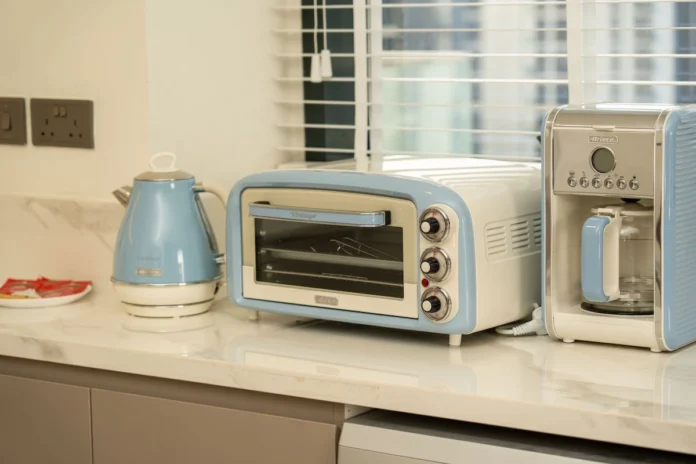
Leave them. A kettle bought in Greece will cost between fifteen and thirty euros, will work perfectly on Greek current, and will not require a transformer or a customs declaration. The same applies to toasters, hand mixers, rice cookers, and waffle makers. Shipping these items is, in plain terms, a waste of money.
Microwaves
Microwaves are bulky, heavy, and inexpensive to replace in Greece. A standard mid-range microwave from a Greek electronics retailer costs between sixty and one hundred and twenty euros. Ship one only if it is a high-end combination oven with a configuration you would struggle to find locally.
Bread makers and specialty appliances
Bread makers occupy an interesting middle ground. They are lightweight relative to their size, which makes shipping costs lower than you might expect. And in Greece, where bakeries are genuinely excellent and often open early, many people who were devoted bread-machine users in North America find they simply stop using them. The honest question is not whether to ship the bread maker, it is whether you will still want it once you are buying fresh bread from a village bakery three times a week.
Specialty appliances with no obvious European equivalent — a particular style of waffle iron, a specific brand of air fryer, an unusual kitchen gadget — are worth evaluating individually. If it is truly irreplaceable and genuinely used, bring it. If it is something you reach for twice a year, leave it.

The Lifestyle Shift That Changes Everything
What the appliance guides never quite capture is how much daily life in Greece changes the way people cook and eat — and therefore which appliances they actually need.
Produce markets operate year-round. Village bakeries open before seven in the morning. Olive oil, cheese, and fresh fish are bought locally and often informally. Shopping happens several times a week rather than once every ten days, which means the giant refrigerator stuffed for the week and the appliances built around batch cooking gradually become less central to how the kitchen is used.
Many retirees who moved to Greece with a full set of North American appliances report that within a year, several of them had not been touched. The juicer, replaced by pomegranates from a neighbour’s tree. The bread maker, replaced by the baker down the road. The food processor used monthly rather than weekly.
This is not a guarantee. People cook differently, households vary, and if you are someone who bakes seriously or cooks specific cuisines that require specific equipment, that matters. But it is worth sitting with the question honestly before the shipping company arrives.
The Question That Settles It
If you did not already own this appliance, would you pay to import it into Greece today at full shipping cost, plus transformer, plus customs risk?
That question reframes the decision correctly. The fact that you already own something is not, by itself, a reason to ship it halfway around the world. Sunk cost is not a moving strategy.
Bring the things you love and will genuinely use. Replace the everyday items locally. And give yourself permission to discover that a Greek kitchen, built around Greek habits, may turn out to suit you better than the one you left behind.
***
Planning your move to Greece involves hundreds of decisions, and this article covers just one of them. The Greece Retirement Blueprint walks you through everything else — visa options, taxes, healthcare, banking, property, and daily life — in one comprehensive 104-page guide. Download your copy and arrive prepared.