

Settling in a town that works for every generation of the family
This text is a testimonial by Vangelis Koumarianos, a Greek retiree describing his experience living in Nafplio. He grew up on the island of Tinos and spent most of his professional life working as an executive director in Athens. After retirement, a family decision brought a new chapter: his son returned from Germany with his wife and their two children, and the family chose to settle in Nafplio. Wanting to be close to them, he also relocated there.
Today, his everyday life unfolds in a town where his circle is not exclusively Greek but shaped by different cultures and experiences. What follows is a personal account of daily life in Nafplio, seen through the eyes of someone who knows both the pace of large cities and the quieter rhythms of provincial Greece.
By Vangelis Koumarianos
Nafplio is undoubtedly one of the most beautiful towns in Greece, with a mild climate and flat terrain. Despite its continuous expansion, the town has preserved its original core, with a strong Italian (Venetian) character. It is built at the head of the Argolic Gulf, in the shadow of the well-preserved Venetian fortress of Palamidi, with the island-fortress of Bourtzi standing as the constant guardian of its shallow harbor.
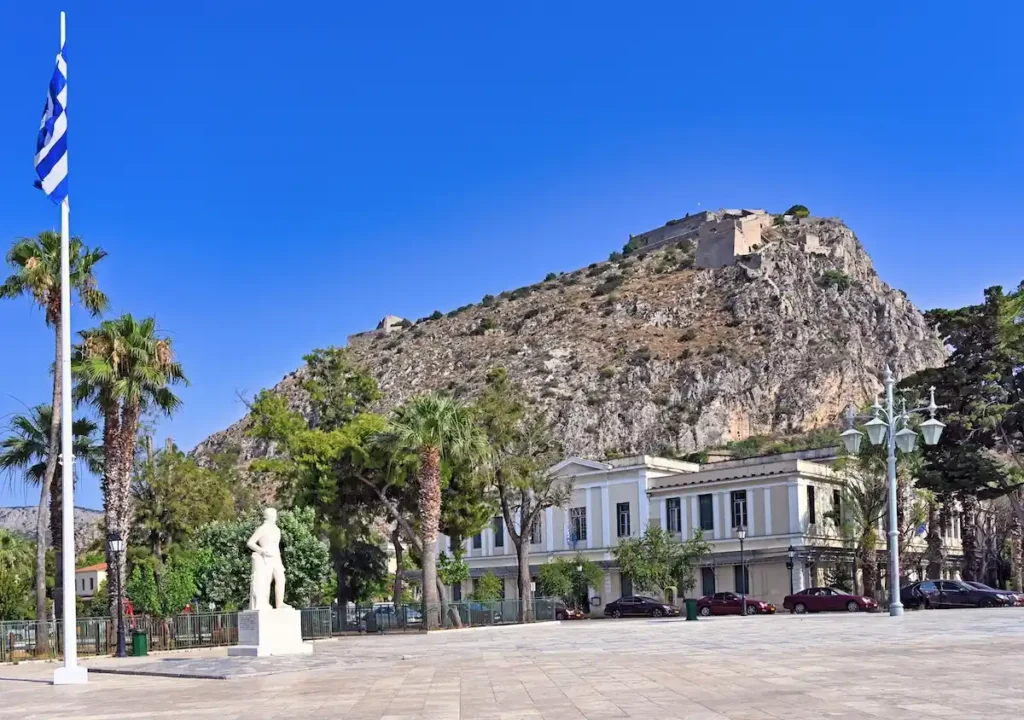
Beyond its natural beauty, Nafplio boasts many remarkable monuments from the past, including Venetian fortresses, Ottoman buildings, and more recent structures connected with the birth of the modern Greek state, of which Nafplio was the first capital. It should also be noted that just a few kilometers from the town lie important ancient monuments, such as the ruins of Mycenae and the theater of Epidaurus.
All of the above, combined with easy road access from Athens (145 km), make Nafplio an attractive destination for both Greek and foreign visitors throughout the year. During holidays and weekends, visitors flood the town, filling the streets, cafés, restaurants, and shops, creating an atmosphere of liveliness, joy, and carefree relaxation.
We, however, are no longer visitors but permanent residents, since we decided to settle permanently in our beloved town, which we have been visiting for many decades. The main reason for our move is that our son’s family relocated to Nafplio after returning from Germany, together with his wife and our two grandchildren.
Let us see, then, how we experience Nafplio in everyday life.
As a provincial town, Nafplio moves at the typical—one might say slower—pace of the countryside, in contrast to the frantic rhythm of large cities such as Athens. This translates into a calm start to daily life for residents, who reach their workplaces, schools, shops, and other destinations without difficulty or delays. The day continues at the same pace, as those who are not working go out for shopping, walks, or social meetings. The flat terrain, as mentioned earlier, makes it easy to get around and reach the center from any point without needing a car. Things would be even better if there were more bicycle lanes in addition to the single one that currently exists.
In Nafplio one can find all kinds of food shops and retail stores, with a wide variety and sufficient supply of goods, as well as service offices. Supermarkets are located in various parts of the town, both in the center and on the outskirts. Outside the center, there are generally stores for building materials, home goods, car repair shops, and similar businesses. Every Wednesday and Saturday there is an open-air market in town, with a wide variety of vegetables, fruits, and other products, most of them locally produced.
There are many different places for walking and recreation. The old town itself is ideal for walks, with its picturesque streets lined with preserved historic buildings and its squares. A particularly beautiful walk is the circuit of Arvanitia, an easy route of about one kilometer along a paved path on the slopes of the Akronafplia hill and beside the sea. For more exercise, there is also the equally beautiful route from Arvanitia to Karathona beach, a path of about 2.5 km along the foothills of the Palamidi rock, next to the sea. It is an ideal route for exercise, with some moderate but not excessive difficulty. Around Nafplio there are several beaches for swimming, the nearest being Karathona, a shallow, sandy beach over two kilometers long, about 4 km from the town. Finally, besides the many cafés and restaurants in town, there are also tavernas serving meat or fresh fish outside the town and in the surrounding villages.
Nafplio and the surrounding area are suitable for water sports (the town also has a marina), swimming, hiking, rock climbing, and more, as well as for day trips to regions and sites throughout the Peloponnese and Central Greece (Ancient Olympia, Mystras, Monemvasia, Vytina, Dimitsana, etc.), and to the islands of the Argosaronic Gulf (Hydra, Spetses, etc.). Cultural events of all kinds take place throughout the year, while in the summer, theatrical performances are held at the ancient theater of Epidaurus.
If we add to this the safety provided by the town and the surrounding area, the availability of public healthcare services—mainly at the well-equipped hospital of Argos (10 km from Nafplio), alongside private doctors of all specialties, as well as public transportation and frequent connections between towns and Athens, it becomes clear that Nafplio and its region constitute an ideal destination, one might say, for both temporary and permanent residence. This is especially true for older people and retirees seeking a peaceful and secure living environment. Among the disadvantages of the area, one should mention the high temperatures during the summer months (July–August), which often reach 38–40°C.
As for the cost of living, I would say it does not differ significantly from other parts of Greece, with the possible exception of rents and property values, which, due to high demand, continue to rise.
The residents of the town are mostly locals, although there is also a steady influx of newcomers from surrounding areas. Foreigners (both Greeks from elsewhere and non-Greeks) generally do not encounter difficulties in adapting and are accepted without racial or religious discrimination. This does not necessarily mean that they become fully integrated with the locals, since everywhere, to some extent, full integration of newcomers, especially foreigners of different nationalities who do not speak the local language, is not easy. Nevertheless, relationships with locals do develop, and it is also largely possible to maintain contact with other foreigners already settled in the area.
As for religion, the inhabitants and churches belong to the Orthodox faith. Within the town of Nafplio there is a small Catholic church, but it does not operate regularly.
***
Nafplio combines deep historical roots with a sophisticated urban rhythm, and those exploring the practicalities of a permanent move can find essential data on neighborhoods and local amenities in our guide to relocating in Nafplio before finalizing their property search in the Peloponnese.