
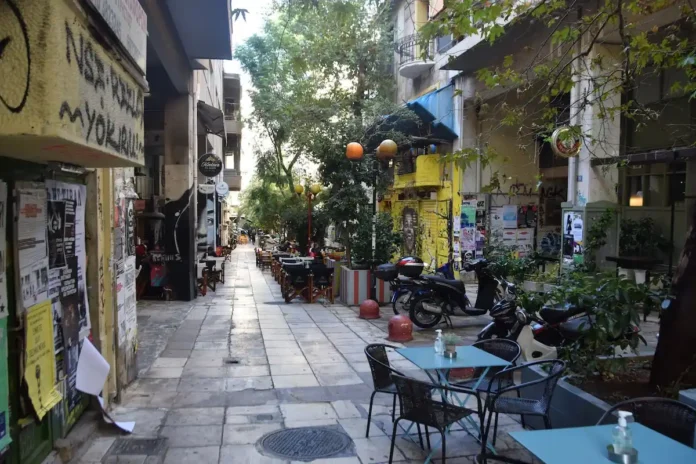
Two realities, one small neighborhood, existing side by side
Read the news about Exarcheia and you’ll find real, well-documented reports of anarchist groups clashing with police, molotov cocktails thrown at riot lines, and organized crime that once operated in the shadows of political unrest. All of that is accurate. Walk the same streets on any ordinary day and you’ll find a different reality, just as accurate: a dense, functioning community of solidarity groups running social kitchens, political collectives debating in packed cafés, working artists, generations of publishers and booksellers, and a genuine intellectual life that has outlasted every riot.
These are not competing versions of the truth. They are two realities that exist here at the same time, layered over the same few blocks: the neighborhood that fights the police on Saturday night and feeds its neighbors on Sunday morning.
That contradiction is not new, and it is not accidental. Exarcheia has spent more than a century being both a refuge for ideas and a flashpoint for confrontation, sometimes on the same street corner within the same hour, and neither side of it has ever managed to fully absorb the other. Anyone weighing whether to live here is really weighing that same contradiction: not whether the riots are real, they are, but whether they actually get in the way of a life built around cafés, bookshops, a market, and neighbors who look out for each other. None of it is written to settle the argument over what Exarcheia “really” is.
What the reports get right
The clashes are real, and they have been going on for more than fifty years. For decades, an unspoken arrangement kept police largely out of the neighborhood’s core: an informal “asylum” that let radical politics, squats, and solidarity movements flourish largely undisturbed. After any political demonstration, the pattern was much the same: some anarchists would join in, stir up violent confrontations, and then retreat into Exarcheia to hide. Successive governments treated containing that violence within Exarcheia’s borders as an acceptable trade-off for keeping the rest of Athens undisturbed.
Today, the heavy, permanent police presence in the neighborhood has two direct causes. The first goes back to 2008, when police killed a teenager here and the riots that followed spread well beyond Exarcheia’s own streets, becoming the most violent weeks the capital had ever seen. The second is more recent: in 2014, plans were announced to turn the central square into a metro station, and fears grew that the project would accelerate gentrification in the area. Construction did not begin until 2022 and groups opposed to the project began attacking the construction site itself.
Where the rebellion started
The politics did not appear overnight. The seeds go back to the late nineteenth century, when the National Technical University, universally known as the Polytechnic, and the School of Fine Arts settled into the neighborhood and filled it with students, professors, and new ideas. By the early twentieth century, Exarcheia already had its own bohemian streak: publishing houses and print shops clustered along streets like Solonos, and the area developed a reputation as the intellectual and literary heart of the capital, home to poets’ salons, underground presses, and, as far back as 1912, a genuine three-day gun battle between a visiting French anarchist gang and police.
The defining moment came in November 1973, when students barricaded inside the Polytechnic became the symbol of resistance to the colonels’ dictatorship. After democracy returned in 1974, the neighborhood became a natural home for the political left, for anarchists, and for artists who found cheap rent, sympathetic bars, and bookshops willing to stock whatever they wrote.
Presses and Artists That Shaped the Area
Long before anyone threw a molotov cocktail here, Exarcheia was building a very different reputation: this small pocket of streets became the address most Greek publishing houses, like Govostis, founded in 1926 and later based on Solomou Street, and later Gutenberg, Themelio, and Alexandreia, several of them still operating from the same streets today. Solonos and the narrower lanes closer to the square filled in with printers, bookbinders, and book distributors, alongside everyone from small independent presses to mainstream bestseller publishers and university presses, none of whom ever wanted to be anywhere else.
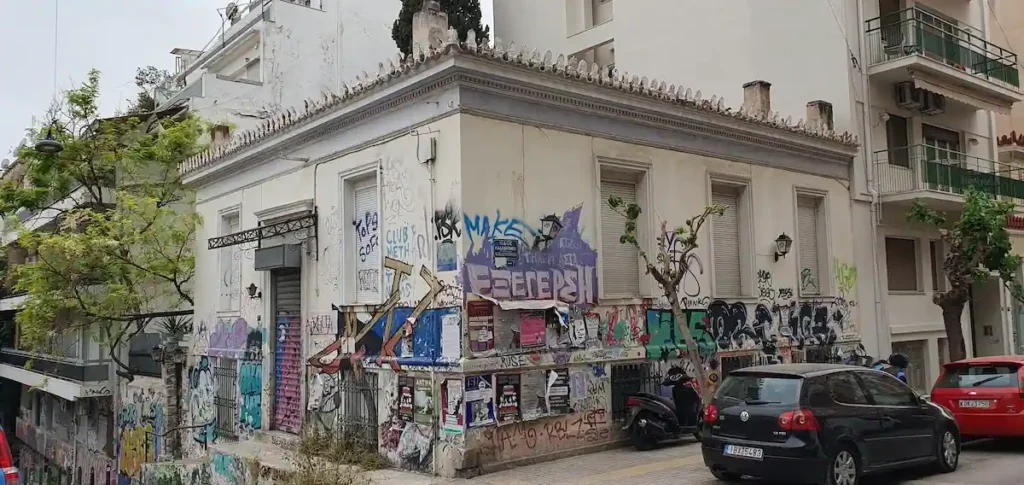
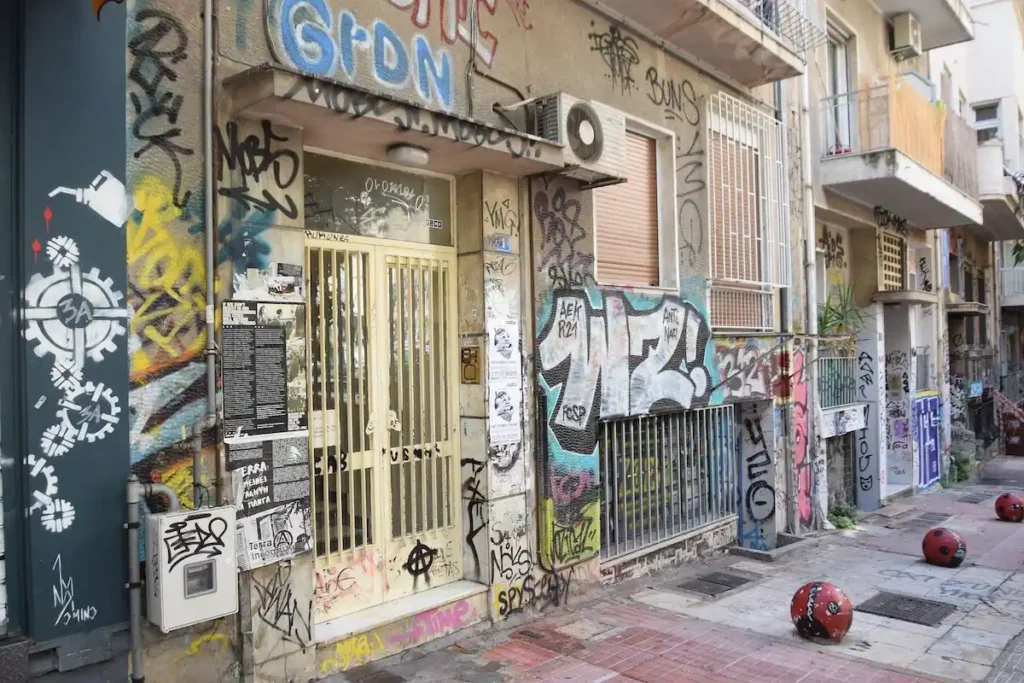
Painters were drawn here too, and across different eras: Nikolaos Gyzis (1842-1901) kept a studio on Themistokleous street, Giorgos Bouzianis worked near Strefi hill, and Yannis Tsarouchis kept a studio on Arachovis street. This painterly tradition has later coexisted with a separate, anonymous visual culture: Today, Exarcheia is covered in murals, stencil work, and posters layered inches thick in places, looking less likevandalism and more like a running, wall-sized conversation about whatever the neighborhood happens to be arguing about that week.
That same density of bookshops, publishers, and art spaces still shapes everyday life in Exarcheia, with book presentations, and events happening on an almost weekly basis, easy, informal ways for a foreign retiree to meet people and feel part of the city rather than just living in it.
The night that changed everything
On the night of December 6, 2008, the feast of Saint Nicholas, fifteen-year-old student Alexandros Grigoropoulos was fatally shot by a special police guard at the corner of Mesolongiou and Tzavella streets, after a brief verbal exchange between his group of friends and a passing police patrol. What happened next was unlike anything Greece had experienced before in the digital age. News of the shooting spread almost immediately through mobile phones, text messages, blogs, Indymedia and the rapidly expanding social networks.
What became known simply as “the December” turned into the largest and most sustained youth uprising the country had seen since the restoration of democracy in 1974: high school students, university students, and progressive citizens far beyond any political fringe poured into the streets of Athens and other cities for days on end.
The damage was severe enough that a leading newspaper called it the worst unrest since 1974, with the Athens Chamber of Commerce later estimating losses in the capital alone at more than fifty million euros; several hundred shops, malls, hotels, and bank branches along central avenues were burned, looted, or damaged, and the city’s Christmas tree in Syntagma Square was set alight.
The corner where Grigoropoulos died is known informally today as the Alexandros Grigoropoulos pedestrian street, marked by a marble memorial plaque that is rarely without fresh flowers, handwritten notes, and political graffiti. Every December 6, the ritual repeats: student marches at midday, larger demonstrations by evening, and Exarcheia turning once again into a heavily policed operational zone, reliving, in scale if never quite in intensity, the night that made the neighborhood a national symbol of resistance rather than just a bohemian corner of Athens.
This is also the clearest practical warning in this whole piece: outbreaks of tear gas and molotov cocktails happen with little notice, and when they do, people nearby need to move quickly, which makes the neighborhood a poor fit for retirees with respiratory conditions or limited mobility.
A woman can walk home alone at 3am
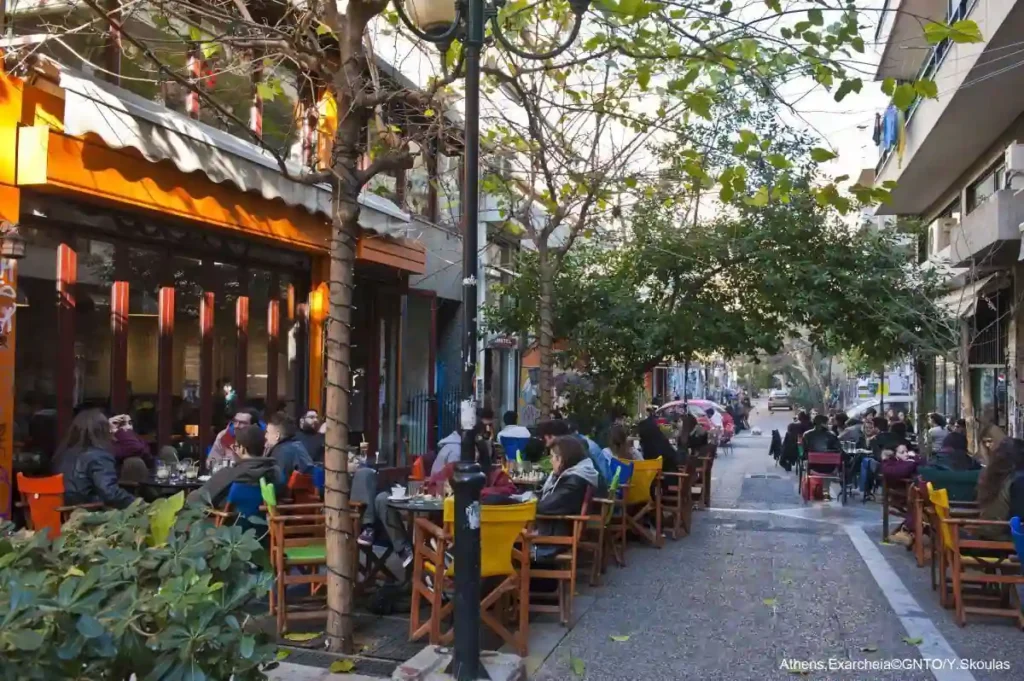
Here is the part that surprises most newcomers: despite the reputation, walking alone at night here is no riskier than in most of central Athens. In 2026, as in every year before it, a woman can walk through the neighborhood alone late at night, stop at an all-night kiosk, and head home after a few hours in a bar without a second thought, much as she could in most of the Athens municipality, since the real exceptions are a handful of specific spots like Omonia, Vathi, and Kolonos, not Exarcheia. Locals will tell you the political violence here is almost entirely self-contained, aimed at police, property, or occasionally organized crime, and rarely spills over into random street crime against residents or visitors. The same solidarity culture that produces radical politics also produces a strong informal watchfulness: neighbors who know each other, squats with their own rules, and a community that, for all its chaos, looks out for its own.
Robocops on the corner
What has genuinely changed in the past few years is the atmosphere around the central square, and the cause is a single infrastructure project: the long-fought decision to build a metro station on Exarcheia Square. Resident groups took the case to the country’s highest administrative court, which ultimately sided with the metro authority, though residents did win a smaller victory forcing the company to keep a minimum walking width on Themistokleous street. Construction now proceeds behind a fortress of steel barriers, guarded around the clock by riot police units and dedicated public order teams under a security plan reportedly deploying several hundred officers.
The effect on daily life is visible on every corner: clusters of riot police in full gear, ID checks on passersby, and a noticeably heavier police footprint than anywhere else in the capital, set against a street scene of alternative fashion, tattoos, dyed hair, and every strand of punk, goth, and hippie style the city has to offer. The contrast, robocop and rebel on the same pavement, has become the neighborhood’s most photographed cliché, and its most honest snapshot.
When the anarchists went after the mafia
One persistent misconception about Exarcheia is that anarchists and organized crime somehow coexist as allies, protected by the neighborhood’s hostility toward the police. The reality has been considerably more complicated. Drug dealing has long been a problem in parts of Exarcheia, and at various times criminal networks have tried to take advantage of the area’s large migrant population, political tensions and limited police presence.
Some anarchist and anti-authoritarian groups responded by confronting drug dealers themselves. During the 2010s, there were repeated clashes between political groups and people involved in the local drug trade, sometimes escalating into violence. In July 2016, an armed group calling itself the “Armed Militia Groups” claimed responsibility for the killing of an Egyptian man known as Habib, whom it accused of running a drug operation in Exarcheia. The killing was subsequently investigated by police as part of a wider conflict involving drug dealers and anti-authoritarian groups in the neighborhood.
This is one of the stranger contradictions of Exarcheia: groups that regard the police as an occupying force have, at times, taken it upon themselves to confront criminal activity they believe threatens the neighborhood. That does not make the neighborhood “self-policing” in any formal sense, nor does it mean that organized crime has disappeared. It is simply another example of the unusual balance of power that has developed here over the years, where political groups, residents, businesses, criminal networks and the state have all competed for influence in the same small patch of Athens.
Foreign funds spot an opportunity
The other force reshaping Exarcheia has nothing to do with politics and everything to do with real estate. Over roughly the past twelve years, property prices have risen several-fold. Around the mid-2010s, apartments in the neighborhood could still be found at roughly €600–700 per square metre; by the late 2010s, prices were approaching €1,000 per square metre, and the rise accelerated sharply during the 2020s as Athens’s property market recovered, short-term rentals expanded and foreign investment poured into the area. By 2026, asking prices for residential property in Exarcheia were averaging around €3,000 per square metre, a remarkable change from the neighborhood’s pre-gentrification prices.
This was driven by several forces at once: the rapid expansion of short-term rental platforms, the recovery of Athens’s property market and a growing wave of foreign investment. In Exarcheia, Israeli and Chinese buyers have been particularly visible. Research covering property transactions from 2009 to 2018 found that Israeli nationals accounted for the largest number of purchases by foreign individuals in the wider Exarcheia area, with Chinese buyers in second place. Some investors bought individual apartments, while others acquired whole properties or buildings and converted them into short-term rentals, serviced apartments or other hospitality uses.
The interest has continued into the 2020s, as foreign buyers have increasingly viewed central Athens property as a long-term investment. Israeli investors in particular have become a significant force in the Greek market, while Chinese buyers remain an important part of the foreign-buyer story. In Exarcheia, the calculation is fairly straightforward: a neighborhood that was once considered too politically troubled and too unfashionable by much of the property market is now being bought in anticipation of further gentrification, particularly once the new metro station opens. Whether that bet pays off remains to be seen, but the transformation is already visible in the prices and the shrinking supply of affordable long-term rentals. For anyone considering a move to Athens, finding a suitable long-term rental has become a challenge in its own right.
Saturday morning on Kallidromiou street
None of the politics, the police, or the property speculation fully explains why people who live here refuse to leave. That has more to do with the Saturday market on Kallidromiou street, known as “laiki agora”, widely considered the neighborhood’s true heart, where old-timers, students, anarchists, immigrants, and curious tourists all crowd the same stalls before spilling into the cafés and tavernas that line the street for the rest of the day. It has to do with Strefi hill, the green lung where dog walkers, families with small children, and teenagers with guitars share the same slope and the same view over the city. It has to do with open-air summer cinemas like the Riviera on Valtetsiou street and the Vox on Themistokleous, tucked behind jasmine-covered courtyards and still drawing crowds for classic film nights decades on, with decades-old taverns where students eat cheaply and old residents argue about politics, and a network of solidarity kitchens and resident assemblies that still function as an informal social safety net. Exarcheia also carries a publishing legacy that predates its politics: a dense cluster of bookshops and independent publishing houses going back to 1906, drawn originally by the university crowd and later by the neighborhood’s appetite for ideas nobody else would print.
Who Exarcheia actually suits
This is not a neighborhood for anyone chasing quiet, predictable retirement living, and it was never going to be marketed as one. It suits people who want to live inside a genuinely intellectual, artistic, politically engaged corner of the city: people who don’t mind the occasional smell of tear gas drifting through an open window in mid-November, who find riot police on the corner more curious than alarming, and who value a strong sense of community over manicured streets. Renting here now takes patience, competitive timing, and a tolerance for rising prices tied to metro speculation. For the right kind of newcomer, though, few Athens neighborhoods offer this density of history, art, argument, and unfiltered street life in exchange.
Exarcheia is not an easy neighborhood for anyone who has difficulty with hills, uneven pavements or stairs. The district rises toward Lycabettus, many streets are steep, older pavements can be narrow, and parking is difficult. The new metro station will eventually transform access, but the current construction is itself a significant disruption. Before signing a lease, walk the exact route between the apartment, supermarket, pharmacy and nearest public transport at the time of day you expect to use them.
REFERENCE
Official visitors' guide to the City of Athens: Exarcheia Neighbourhood Guide
***