
A book that sends you out to walk before you choose a neighbourhood
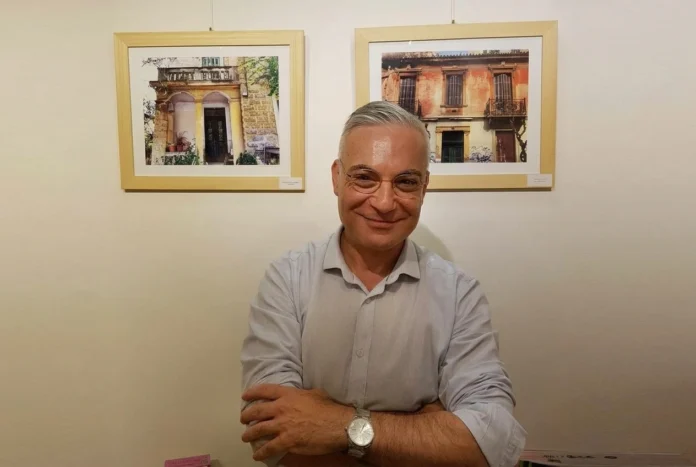
Nikos Vatopoulos has spent decades walking through Athens with the curiosity of someone who refuses to believe a familiar street has nothing left to reveal. Journalist, art critic and photographer, he is one of the best-known chroniclers of the capital. In Greek he is called an Αθηναιογράφος, literally an “Athens writer”: someone who writes the city the way others write history or fiction. His subject is the detail that is easily overlooked, such as an old doorway, a marble staircase, an elaborate balcony or a neoclassical house caught between the apartment buildings that transformed Athens in the second half of the twentieth century.
Every Saturday in Athens
In 2011 Vatopoulos turned this way of seeing into a shared experience with Κάθε Σάββατο στην Αθήνα (Every Saturday in Athens), a walking group for Athenians curious about the history, architecture and stories of their own city. Hundreds of people took part. The walks invited them to look again at neighbourhoods they thought they knew completely, and to discover that the familiar becomes unfamiliar again once you slow down and pay attention.
Walking in Athens, the book
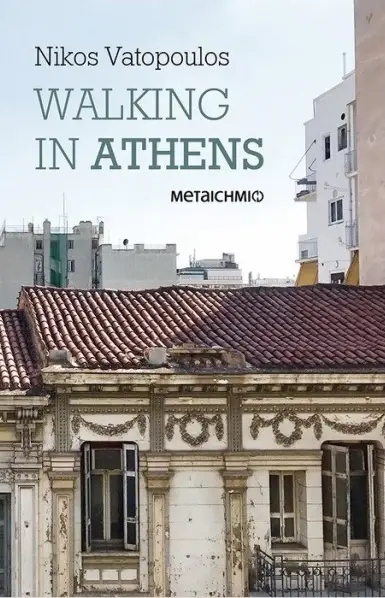
Walking in Athens grew out of those walks. It is a collection of short personal texts and black-and-white photographs taken by Vatopoulos along the way, and it makes no attempt to explain the city street by street. The chapters pass through Exarcheia, Kypseli, Patissia, Pangrati, Mets, Omonia and the streets around the commercial centre, but observation matters more than geography.
His photographs follow the same instinct. Surfaces, shadows, doors, windows and fragments of buildings take the place of postcard views, and a detail that seems insignificant suddenly deserves a second look. Much of his attention goes to nineteenth- and twentieth-century architecture and to the contrasts of rapid growth: a neoclassical house beside a post-war polykatoikia, an entrance hall that keeps craftsmanship found nowhere else, a neglected villa that says something about the social history of its neighbourhood.
The city as memory
A personal history lies behind this fascination. Vatopoulos grew up in Athens, and one childhood memory has stayed with him: a house on Patission Street (the avenue that gives its name to the Patissia district) that was later demolished. Its disappearance shaped his understanding of Athens as a city where one layer replaces another while traces of the past stay embedded in the streets.
For this reason the book is about more than architecture. A staircase can evoke a vanished way of life, a house can recall the people who lived in it, and a demolished building can remain present in the memory of anyone who knew it.
Why the book matters if you are thinking of living in Athens
Anyone considering Athens as a place to live, rather than somewhere to visit, will find the question changes. Ultimately, what matters is less what a city offers its visitors than how its neighbourhoods feel, how they developed and what their buildings tell you about the people who have lived there. The difference between one street and the next can be as interesting as any formal attraction.
Vatopoulos offers no checklist. He offers something more useful: a way of looking. Several of the areas in his book, including Kypseli, Pangrati, Patissia and Mets, are residential districts where many people actually live, which makes his pages a natural starting point for choosing where to base yourself.
How to use the book on your walks
Read a few pages, then go outside. Walk through a neighbourhood you think you know, or one you are considering, without rushing towards a destination. Look above the shopfronts, notice the entrances and balconies, study the older buildings and wonder what stood there before. Visit the same street in the morning and again in the evening, and take a different way home. Over time you begin to recognise the layers Vatopoulos has spent his career recording.
The reward is an Athens that feels less like a collection of places and more like a city with a memory. The book is small enough to carry along, although it may have the unfortunate side effect of making the walk considerably longer.
PUBLICATION DETAILS
Nikos Vatopoulos, Walking in Athens, English translation by Joshua Barley, Metaichmio Publications, 2019
Original Title: Περπατώντας στην Αθήνα, Metaichmio Publications, 2018, 176 pages
***