
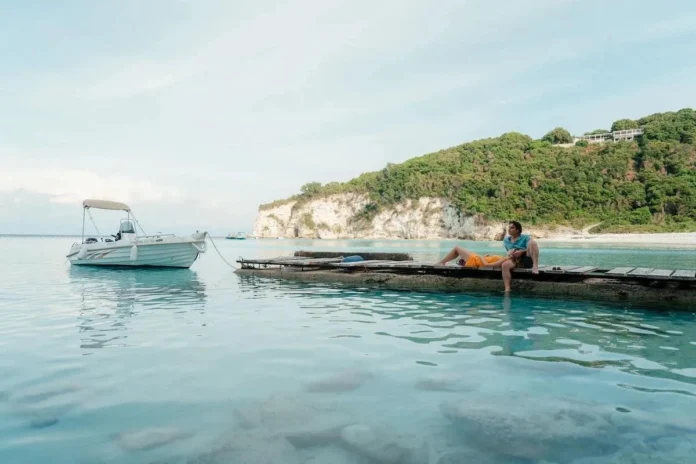
How the island’s landscape drives the drama, and what that means for living there year-round
A troubled musician arrives on a tiny island to revive its summer festival, falls for the mayor’s 19-year-old daughter, and gets pulled into a murder that slowly exposes the town’s private wounds. That’s the engine of Maestro in Blue, and the love story and crime plot are what most people talk about. But for anyone weighing retirement on the island where it was shot, Paxoi, what lingers after the credits is how the place itself is used in the storytelling.
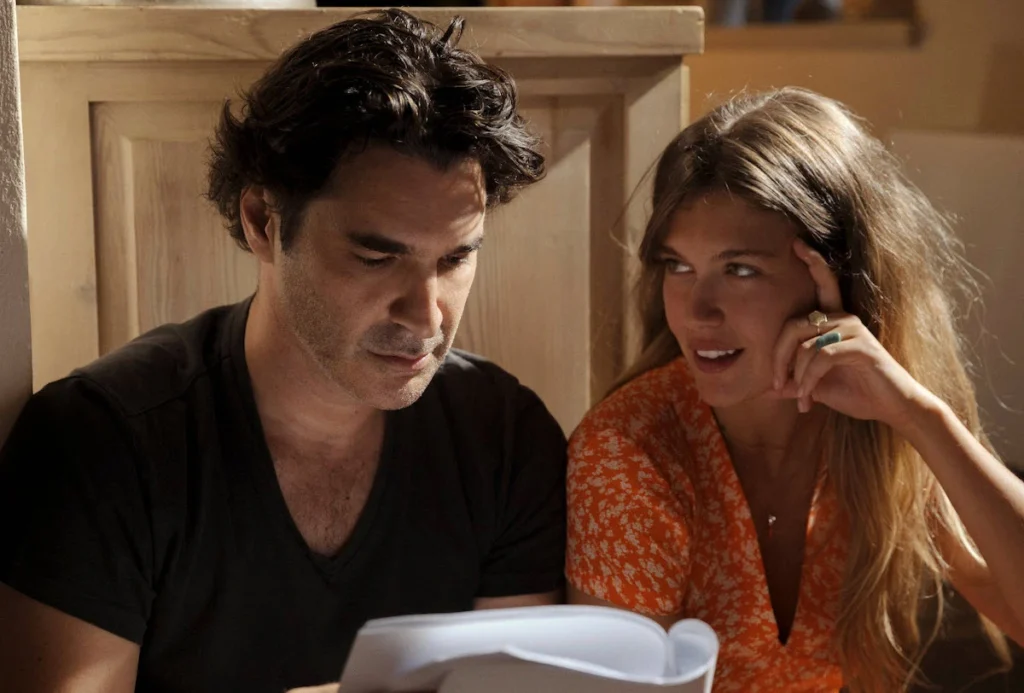
Christoforos Papakaliatis wrote, directed, and stars in the series as Orestis, a musician who travels to Paxos to relaunch the island’s music festival after the pandemic and ends up entangled in a relationship with a much younger local woman while getting drawn into his neighbors’ troubles. Around him, Haris Alexiou, one of the most beloved and enduring female voices in Greek music, appears in a rare on-screen acting role, and even sings within the story. Maria Kavogianni and Fanis Mouratidis round out an ensemble whose storylines carry as much weight as the central romance.
A homophobic household, and a generational question
One of the show’s more difficult threads follows two young men on the island hiding a relationship from their families: one from a well-off, socially prominent household, the other from a poorer one, with a father whose temper and prejudice make secrecy feel like the only option. It’s a hard storyline to watch, and it’s meant to be. Whether it reflects where Greek family life actually stands today is a fair question. Athens, and much of urban Greece, has moved considerably on this in recent years, and plenty of families would find the show’s portrait dated rather than familiar. Paxoi’s version, though, is a small, close-knit island community, where reputation travels fast and everyone’s business is everyone else’s, and that setting shapes how plausible the fear in the story feels.
The landscape as pressure, not decoration
The show’s slow, drifting pace echoes the actual rhythm of life on Paxos, and that pacing is where the landscape earns its place in the story rather than sitting behind it. Paxoi’s cliffs and olive groves don’t soften what’s happening on screen; they intensify it. A murder plot, an affair, a hidden relationship, a violent father: everything plays out in a place small enough that nothing stays hidden for long, and the same beauty that makes the island look like paradise is also what traps its characters inside a town where privacy barely exists. The chemistry between the leads and the sheer visual force of the setting are, by most accounts, what keeps people watching even when the plot wobbles.
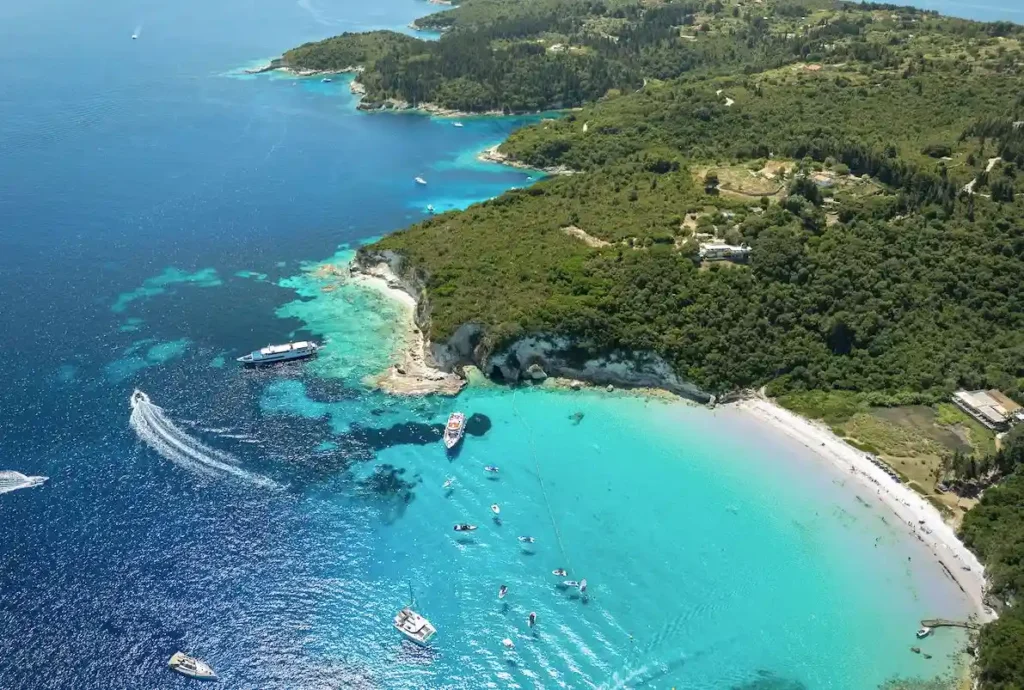
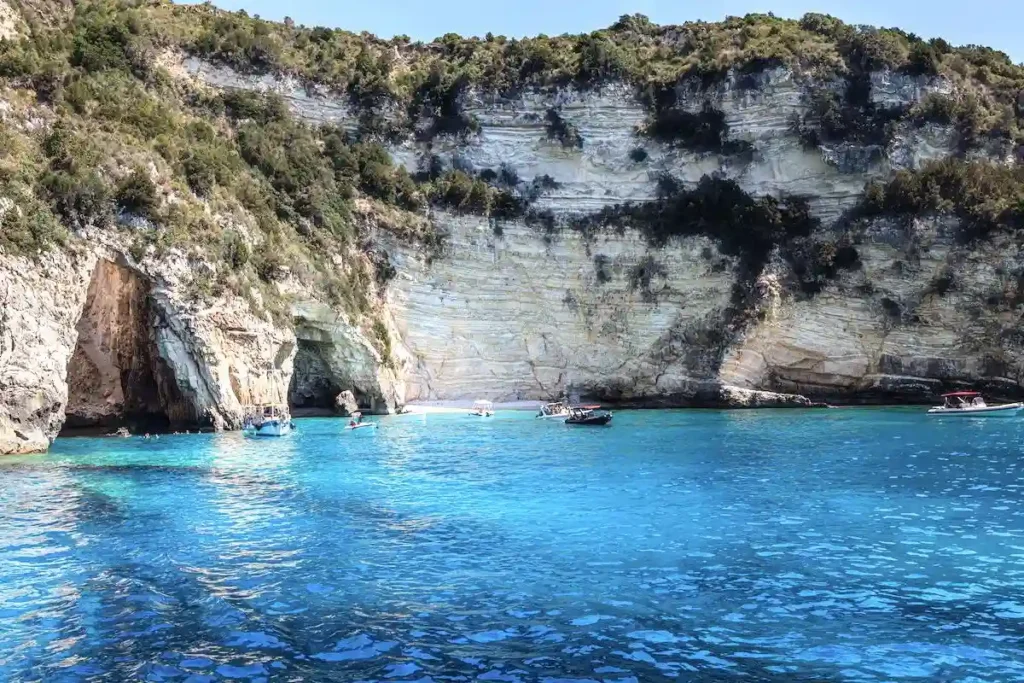
That distinction matters for a retiree considering the island for reasons beyond a Netflix trailer. The visual drama depends on a specific, sun-heavy version of Paxoi: the electric water, the drone shots of limestone cliffs, the golden light over Gaios harbor. That version exists roughly from May to September, and it’s worth being honest about that before treating the show’s imagery as a preview of daily life.
A landscape that changes character with the season
Paxoi’s two constants, on screen and off, are its dense olive groves and its unusually vivid water. The interior of the island, where much of the show’s foot traffic happens, is covered in centuries-old olive trees that form a shaded, silver-green canopy over the walking paths and keep the interior cooler than the coast. Gaios, the capital, is a narrow, fjord-like harbor sheltered by the islet of Agios Nikolaos, where fishing boats and yachts share a waterfront lined with pastel Venetian-era buildings, one of the show’s most recurring locations.
The island the cameras capture in July looks little like the island a retiree lives in come December. From roughly May to September, Paxoi fills with sailing traffic and visitors and takes on the international, sun-drenched character the show trades on. Once the season turns, much of that closes: restaurants and businesses shutter, and daily life narrows to olive harvesting and smaller, quieter gatherings. The crowds, the light, and the sense of a place performing for an audience all disappear, leaving a real, unhurried tranquility that asks for genuine comfort with solitude. Anyone drawn to Paxoi by the show’s imagery should ask honestly whether they want the island in its quiet, half-shuttered winter state, not just its blue-and-gold summer one.
Community life and daily practicalities
The show’s other accurate detail is social rather than scenic: the town square and the local kafeneio function as the community’s shared living room, on-screen and off. With a year-round population that stays well under three thousand, socializing happens in a small number of fixed spots, and new residents tend to become recognizable faces quickly rather than staying anonymous strangers.
Getting around reflects the island’s scale. Paxoi runs roughly ten kilometers end to end, so nothing sits far from anything else, but the roads are narrow and the terrain hilly, and a reasonable level of mobility makes a real difference in how much of the island someone can comfortably enjoy. Just to compare, nearby Kefalonia is vastly larger at over 750 square kilometers, shifting the scale of travel entirely within the same Ionian waters.
One practical gap is worth naming clearly: Paxoi has no major hospital. Primary care runs through a local health center, and anything beyond that means a hydrofoil to Corfu, a trip of under an hour, a detail worth weighing for a permanent, year-round move rather than a summer visit.
Maestro in Blue sells Paxoi at its most cinematic. The real decision for a retiree is whether the island still appeals once the drone shots stop and the season turns quiet. Originally a Greek television series, it later reached Netflix internationally, becoming the first Greek series to screen on the platform.
If you are interested in exploring series and cinematic productions that beautifully capture Greek landscapes, you can watch The Island, which was filmed on the historic fortress of Spinalonga. Beyond the screen, you can also dive deeper into regional geography by exploring a dedicated guide to the Peloponnese landscapes that echo the epic journeys of Christopher Nolan’s The Odyssey.
TV Series Title: Maestro (Greece) / Maestro in Blue (International), Directors: Christoforos Papakaliatis and Akis Polizos, Production: Foss Productions, Beside Productions, and MEGA TV, Year: Season 1 (2022), Season 2 and 3 (2024)
***