

What Every Foreign Retiree Needs to Know Before Driving in Greece
One of the practical pleasures of settling in Greece is the freedom to drive, to reach the village perched above the coast, the weekly market in the next town, or simply the pharmacy without depending on anyone else. Before you can do any of that legally, however, you need to sort out your driving licence, and the rules differ considerably depending on where yours was issued. Getting this right early will spare you from fines, insurance headaches, and the unpleasant surprise of being told your licence is no longer valid.
EU and EEA Licence Holders: The Easy Path
If your driving licence was issued by a country within the European Union or the European Economic Area, your situation is straightforward. EU and EEA licence holders do not need to exchange their foreign driving licence as long as it remains valid. Unlike non-EU country licences, you can keep using your permit without an IDP or exchange even after becoming a resident in Greece. If your licence expires while you are living in Greece, you can renew it locally through the regional transport authority without having to travel back to your home country. There is no mandatory conversion, no test, and no deadline bearing down on you. Simply keep your licence current and you are legal.
Non-EU Licence Holders: Understanding the Timeline
For retirees arriving from outside the EU, whether from Canada, the United States, Australia, the United Kingdom, or elsewhere, the rules require more planning. You may drive in Greece on your foreign licence, accompanied by an International Driving Permit if your licence is not printed in Greek or Latin characters, for a defined period. A foreigner is considered a resident of Greece if they stay for more than 185 days within 12 months. Once you cross that threshold and establish what the law calls normal or habitual residence, you have approximately six months to obtain a Greek driving licence. After that window, your foreign licence is no longer legally recognised for driving as a resident, and driving on it would expose you to fines and potential insurance complications.
It is worth being clear about what triggers this obligation. It is not simply the date printed on your residence permit. It is the fact of having genuinely established your life in Greece, your home, your routines, your ties. The permit is evidence of that status, but the practical countdown begins when you are truly living there.

Which Licences Can Be Exchanged Directly
Here is where many guides go wrong, and where it pays to rely on official sources. Greece has bilateral mutual recognition agreements that allow direct exchange, meaning you hand over your foreign licence and receive a Greek one without sitting any examinations. This procedure applies to licences issued by the United States, Canada, Australia, Japan, South Africa, and South Korea. Switzerland, Serbia, Albania, and the countries of the former Soviet Union are also included for expatriates.
The United Kingdom occupies a distinct category. The conversion of a valid UK licence to an equivalent Greek driving licence is available to those who have acquired habitual residence in Greece and are beneficiaries of the Withdrawal Agreement. In practice, this means UK nationals who were already resident in Greece before the end of the Brexit transition period, or who have since established residence under the terms of that agreement, can exchange their licence directly. If you are a UK national planning to retire to Greece, it is worth confirming your specific eligibility with the local transport authority before assuming a direct swap applies to you.
Greece has also been expanding its agreements in recent years. In September 2024, Greece and Georgia signed a mutual recognition agreement, illustrating that the list of partner countries is not static. Always verify the current situation through the official Greek government portal at gov.gr, as agreements can and do change.
If your licence was issued by a country not on any bilateral list, the process is more involved. You would need to register with a Greek driving school, complete the required coursework, and pass both the theory and practical examinations in Greek.
The Conversion Process, Step by Step
If you qualify for direct exchange, the process is administrative rather than daunting, provided you arrive prepared. Before anything else, you will need your AFM (Greek tax identification number) and your Taxisnet login credentials, both of which your accountant can arrange. These identifiers are required for virtually every administrative procedure in Greece, and the driving licence exchange is no exception.
Your foreign licence must be accompanied by a certified translation into Greek. This is done through a certified lawyer, your home country’s consulate in Greece, or via approved translation services. The gov.gr portal can point you toward recognised options, but the translation itself is a professional service, not a self-service tool.
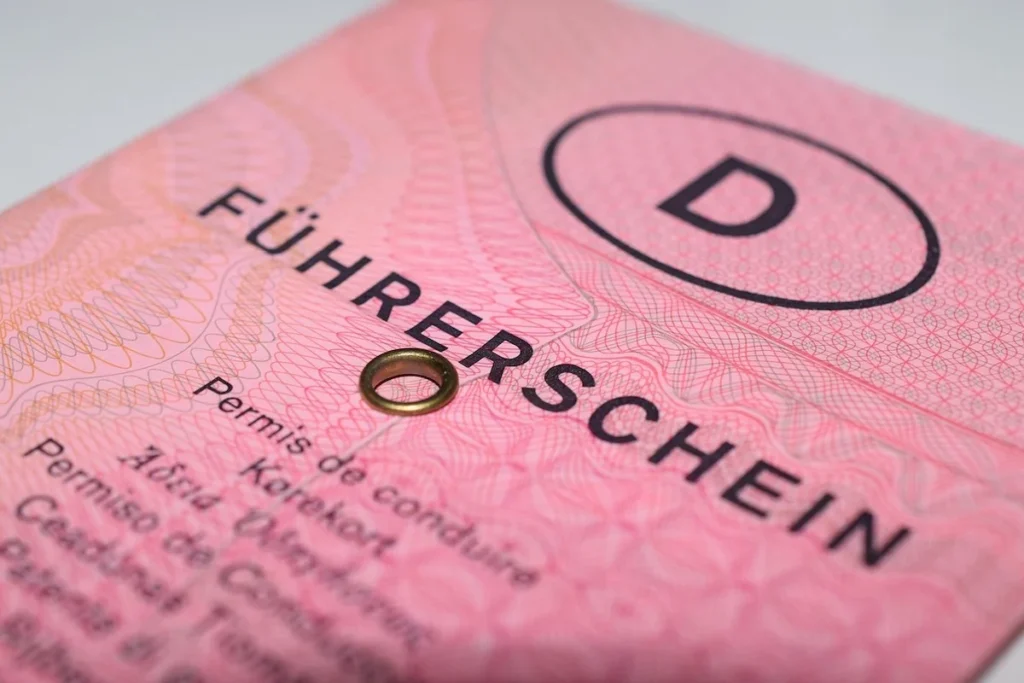
You will then need to see two private doctors contracted with the Ministry of Transport: a general practitioner and an ophthalmologist. The general practitioner will check your blood pressure, heart, and basic medical history; the eye doctor will test your vision and peripheral sight. Both doctors log their findings digitally into the state system. The total cost for these two appointments generally falls in the range of €50 to €80, though this varies by region and practitioner. Once submitted, your medical clearance is valid for six months, so you will want to ensure your full application is submitted before that window closes.
Administrative fees are paid through the e-Paravolo system on gov.gr. The licence printing fee currently sits at €30, with additional stamp duties of approximately €18 for a standard passenger vehicle category. Keep your digital payment receipts, as you will need them at submission.
Your completed file goes to your regional Transport and Communications Directorate or a KEP citizen service centre. It should include your original passport and a photocopy, your residence permit and a photocopy, your physical foreign licence, the certified translation, proof of your AFM, four recent biometric photographs, and your fee receipts. Staff will verify the file and submit it for processing. Processing times typically run from two to six weeks, though backlogs in some regions can extend this, and waiting times of two to three months are not unheard of. You will be notified when your credit-card-style Greek licence is ready for collection, at which point you surrender your original foreign licence permanently, as it is returned to the issuing authority in your home country.
A Practical Word on Timing
The sensible approach is to begin this process as soon as you have established residence, rather than waiting until you are close to the six-month limit. Administrative appointments, document gathering, translation services, and medical clearances all take time, and any one of them can introduce a delay. Starting early gives you breathing room and ensures you are never in the awkward position of driving on a licence that is technically no longer valid under Greek law.
***