

How to Check if a Realtor Is Officially Registered
Moving to Greece means navigating a property market that works quite differently from what most foreigners are used to. One of the first things worth understanding is that real estate brokerage is a regulated profession in Greece, requiring official registration by law. This means that not everyone who presents themselves as a real estate agent is actually licensed to act as one, and knowing how to verify this before signing anything or handing over any money can save you a great deal of trouble.
This is where many foreign buyers get tripped up. Greece has several professional associations, unions, and federations connected to the real estate industry, and agents will sometimes present their affiliation with these bodies as proof of legitimacy. It isn’t. These organizations operate on a voluntary basis, their registers are private, their membership criteria are self-defined, and belonging to them carries no binding legal effect under Greek law. They cannot issue licenses, they have no regulatory authority over their members, and they offer no enforceable protection to clients. An agent can be a proud member of every association in the country and still be operating illegally.
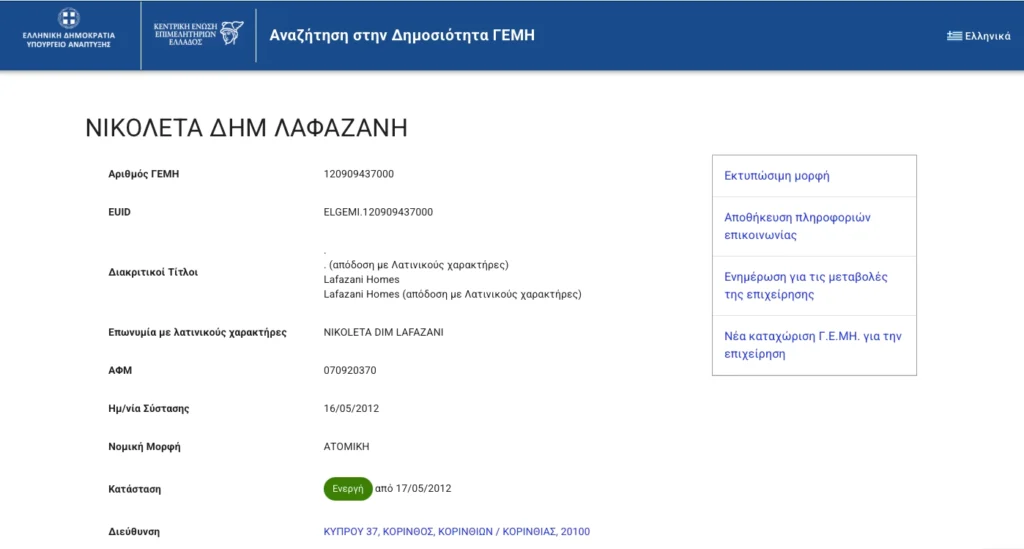
Legal accountability in Greece is established through one thing only: registration in the official Registry of the Ministry of Development of the Hellenic Republic. To legally practice as a real estate agent in Greece, a person or company must be registered with the local Chamber of Commerce and listed in the public commercial registry known as ΓΕΜΗ (Γενικό Εμπορικό Μητρώο, General Commercial Registry). This is the state registry where all businesses and professionals engaged in commercial activity in Greece are recorded. If an agent is not in ΓΕΜΗ with an active status and the correct activity code for real estate brokerage, they are not legally practicing and they have no legal right to charge you a brokerage fee.
How to Verify Whether an Agent Is Licensed
The most direct approach is simply to ask the agent for their registration certificate from the Chamber of Commerce and their certificate from the public commercial registry. A legitimate, properly registered agent will have no hesitation providing these. Refusal or avoidance should be treated as a warning sign.
You can also verify an agent independently by contacting the local Chamber of Commerce for the region where the agent operates. Every regional unit in Greece has its own Chamber, the Athens Chamber of Commerce & Industry (ΕΒΕΑ) being the most prominent, and these Chambers maintain official registries of licensed real estate agents. All local Chambers fall under the Central Union of Chambers of Greece (ΚΕΕΕ) and operate under the supervision of the Ministry of Development. You can call or email the relevant Chamber, provide the agent’s name or Tax Identification Number (ΑΦΜ), and request confirmation of their registration status. A full list of Chambers across Greece is available online.
The other route is to check the public commercial registry yourself, directly through the Ministry of Development’s business portal. The initial pages are available in English. From the page “I want to find information about a company,” click “Go to publicity” and enter the agent’s name, business name, or Tax Identification Number (ΑΦΜ) into the search field. The ΑΦΜ is the most reliable search method if you have it.

What to Look for in the Results
Once you find the listing, which will be largely in Greek, there are a few key things to check. The status should read Ενεργή, meaning Active. There should be a real, physical registered address. And critically, the activity code (ΚΑΔ) must include real estate brokerage or real estate services. The primary activity code for real estate agents in Greece is 68.31, which covers property sales and rentals, with subcategories 68.31.01 (real estate brokerage) and 68.31.02 (real estate brokerage on behalf of third parties). This code may appear as either a primary or secondary activity. At the Athens Chamber of Commerce alone, more than 800 professionals include ΚΑΔ 68.31 in their registration.
What does not count as proof of legal registration is worth spelling out clearly: having a website, appearing in property listings, being paid informally, or holding membership in a professional association. None of these establish that an agent is legally authorized to practice.
Professional Associations: Useful, but Not a License
There are several well-known professional bodies in the Greek real estate sector, including the Hellenic Association of REALTORS (ΣΕΚ), a nationwide organization with its own code of ethics and international affiliations, and the Federation of Real Estate Agents of Greece (ΟΜΑΣΕ), which represents regional associations under a national umbrella. At the regional level, bodies such as the Association of Real Estate Agents of Eastern Crete (ΣΥΜΑΚ) and the Association of Real Estate Agents of Athens–Attica (ΣΜΑΣΑΑ) serve professionals in their respective areas. Membership in any of these may indicate a degree of professional commitment and can be a useful additional signal, but it does not replace official registration, and none of these bodies has the authority to issue a legal license.
Checking an Agent’s Market Activity
Beyond legal verification, you can also get a sense of an agent’s market presence by looking at their profile on major property platforms. On Spitogatos you can view how many properties an agent currently has listed for sale or rent, and how long they have been active on the platform. This is indicative rather than conclusive, but it is a useful way to compare agents in a specific area and gauge their level of activity. Some buyers prefer a smaller portfolio with more personalized attention; others find long-standing platform presence reassuring.
Your Agreement with the Agent
Once you have verified an agent and are ready to proceed, the process typically begins with the signing of a Property Viewing Authorization (Εντολή Υπόδειξης Ακινήτου), which confirms that the agent will show you a specific property and sets the agreed fee, usually 2% for a purchase or one month’s rent for a lease. The final Brokerage Agreement (Σύμβαση μεσιτείας) is signed once the transaction is concluded, and it includes the full legal and technical details of the property, with the agent acting as intermediary between the parties.
Working with a properly registered agent protects you legally, ensures that a lawful brokerage contract can be drawn up, and means that legal remedies are available to you if a dispute arises. Before entering into any agreement or paying any money, always request proof of registration both with the local Chamber of Commerce and in the public commercial registry. It is a simple step that can save you a great deal of trouble.
SOURCES
Brokerage Legal Framework: Law 4072/2012, Articles 197–209 (Gov. Gazette A' 86/2012)
Chambers of Commerce Structure: Law 4497/2017
General Commercial Registry (Γ.Ε.ΜΗ. / GEMI): Registry Verification
***