
A Village of Mastodon Tusks, Mushroom Hunters and Hard Winters
In the museum at Milia, in the regional unit of Grevena, lie a pair of tusks 5.02 meters long. They belonged to a mastodon, they are the largest ever found, and Guinness World Records says so. It is a strange thing to meet in a village of this size, and it sets the tone for the place: Milia is small, but it has more going on than its size suggests.
The Museum That Keeps the Village Open
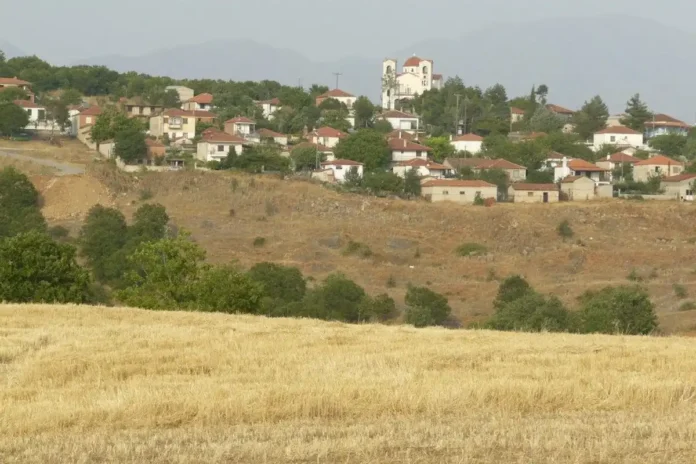
The village is built in a wide amphitheatre, looking toward the Pindus range and, further off, the mountains of Kozani. Oak forest surrounds it. Mountain villages in Greece are usually stacked onto steep ground, with houses pressed against each other and a single lane threading between them. Milia was laid out on a modern plan, with generous plots, so there is room for a garden or an orchard, and for a bit of distance from the neighbors. That matters to anyone who has pictured a retirement with some land attached.
The museum does more than hold a world record. It keeps visitors, researchers and school groups moving through the village all year, and that traffic helps sustain the few tavernas and cafés that a settlement of Milia’s size could not otherwise keep open. A village in February can feel shuttered. Here, the museum gives at least some of them a reason to stay open.
Autumn in the Mushroom Capital
Grevena is known across Greece as the country’s wild mushroom capital, and in autumn the forests around Milia are where that reputation is earned. Foraging is not a pastime here so much as a local way of knowing the land, and it comes with its own cooking: soups, pies, preserves, even liqueurs. A newcomer who walks the forest, learns what is safe to pick, and from whom, will find it a faster route into a conversation than any amount of standing in the village square. One practical warning: wild mushrooms are not something to learn from a book. Go out first with someone who has done it for decades.
Remote in Feeling, Not in Distance
None of this makes Milia isolated, which is the surprise. Grevena, with its hospital, banks, pharmacies, shops and public offices, is about ten minutes away by car. The Egnatia Odos motorway and the E65 are close, putting Kozani about thirty-five minutes off, Ioannina about an hour, and Thessaloniki, with its international airport, about an hour and a half. The price of that arrangement is the car. Errands mean driving to Grevena, and anyone who cannot or does not want to drive should take that seriously.
The Question of January
This is the part that decides whether Milia is for you. Summers are cool and dry, free of the heat that makes July in the Greek lowlands a test of endurance. Winters are long, cold and often snowy, and they dictate how a house has to be built and heated. It is easy to fall in love with a mountain village in September. Staying is a question of January.
Old Stone Houses and What They Really Cost
Property here costs far less than in Athens, Thessaloniki or the popular islands, but the sticker price is only the beginning. Older stone houses often need serious work to be warm and efficient through a mountain winter, and the renovation can absorb much of what the purchase saved. Buying land or building adds planning rules, forest maps and the zoning of traditional settlements, which is why a Greek lawyer and a civil engineer belong in the process before anything is signed. Non-EU buyers should also check whether additional permissions apply to the specific property.
Two Funding Programs, One Caution
The Western Macedonia Region has run a program for installing heat pumps for heating and cooling, with an optional insulation component, at subsidy rates from 65 to 100 percent depending on household income. There is no square-meter limit, and the property must be declared as the main residence by the owner or by a tenant or free-use occupant. For someone restoring an old house in a village with long winters, that could change the arithmetic. Conditions and deadlines move, so confirm them with the Region before counting on anything.
The Ministry of Social Cohesion and Family’s relocation program is a different matter. It offers up to €10,000, in two installments of €5,000, for moving a permanent residence to the Greek periphery. It requires an owned home or a lease of at least three years, and a change of tax residence with AADE, but no local employment. It is aimed, however, at people moving from elsewhere in Greece and at Greeks living abroad. A foreign retiree should not assume eligibility, and should read the official call before building any plan on it.
Arriving as a Neighbor
Milia has no organized foreign community, and the year-round residents are mostly local families, farmers, livestock keepers and older villagers. For a newcomer, that matters less than one might expect, because the village is easy to join. Its cultural association, founded in 1978, is still active and keeps a full calendar: the traditional summer festival in the square, a youth party in the old settlement, and other events through the year. Every one of them needs hands, whether for setting up tables, cooking, serving or clearing up afterwards.
That is the way in. A newcomer does not need fluent Greek to offer help, and does not need an introduction. Turning up and picking up a tray is understood by everyone. Broken Greek, a few words and some gesturing are enough to start, and the effort is noticed. People meet it halfway: locals are glad to switch to English, someone nearby usually speaks it well, and the conversation gets built between the two languages. Friendships here begin this way, over shared work at a festival, long before anyone has mastered the grammar. Your Greek improves because you are using it.
A retiree who takes part in the village’s events, and does not merely watch them, is likely to find a place in the community far sooner than the lack of a foreign circle would suggest.
Before You Decide
Milia suits someone who wants land, quiet, four real seasons and a low-cost village life, who is comfortable driving, and who is prepared to earn a place in a Greek community instead of finding one waiting. Visit more than once, and make one of the visits in winter. Talk to people who live there year-round, and take advice on any property before you commit.
More Places in the Mountains
If you are interested in living in the Greek mountains, explore our relocation guide to Karpenisi, discover the coastal mountain charm of Litochoro near Mount Olympus, or read about peaceful Chrisso nestled beside ancient Delphi.
***