
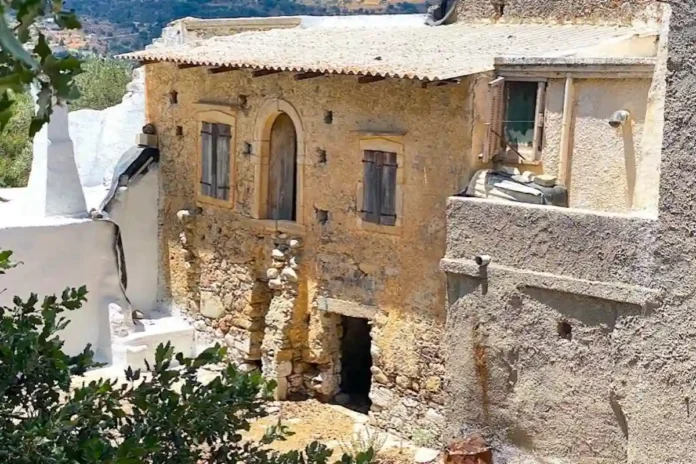
Alan Miller, Property Buyer in Rethymno, Explains Why Restoration Still Hasn’t Started
UPDATED ON OCTOBER 1, 2026
A Scotsman who runs a wedding lighting and events business in Falkirk, Scotland, bought a ruin in Vizari, a half-forgotten village in Crete’s Amari Valley, in 2022, only to discover afterwards that it used to be the village school. This is his story, in his own words.
By Alan Miller
I couldn’t tell you the exact moment Vizari stopped being a dot on the map and became the place. We first came to Crete in 2019, and something about that valley under Psiloritis stayed with us. Vizari is a village that’s slowly disappearing, from three hundred people down to fifty, but the people who are left still lean on each other. One neighbour grows potatoes, another has oranges and goats’ milk, and they simply swap what they have. It’s a kind of life you don’t find much of anymore.
During lockdown I found a ruin for sale online, listed by a local estate agent, on a plot with thirty five olive trees. We flew back out in late 2021, and one evening, over a few offers back and forth with the owner, we agreed a price. In total we spent sixteen days on Crete and came home having bought a house.
We signed the deed in November 2022. It was only afterwards that we found out what we’d actually bought. On paper it was a house, it had been lived in from 1980 to 1990, but it wasn’t built as one. It was the village school, built in 1887, and protected by law since 1990.
The engineer I’d hired didn’t start the paperwork until February 2023. He’d been unwell, though I only found that out much later. We submitted the application two months after that. Fifteen months on, someone from the Archaeological Service finally came out to see the building and confirmed it’s a protected monument. Then they asked for a full list of surveys, structural, architectural, the lot. We had every one of them done, thirty thousand euros in total, and delivered everything on the first of July 2025. Since then: silence.
Over the last three months I’ve phoned the Archaeological Service three hundred times. I’ve counted, it’s all there in my call log. Not once has a person picked up. Just the same recorded message, over and over.
I still love this place. I do. But I can feel that love wearing down a little more with every month nobody calls back. My kids are grown now, and time moves faster than you think it will. I wanted us in that village together while it still meant something, not in twenty years’ time.
This was never just about restoring an old building for its own sake. Once it’s finished it’ll be six bedrooms, room enough for guests, more people staying in the village than have in years. That’s the whole point, not a holiday house sitting empty most of the year, but somewhere that brings a bit of life back to Vizari.
And even the day the Archaeological Service clears us, we’re still not free to start. We’ll need a building permit from the Amari council on top of that, and that alone can take six months. So however this plays out, we’re always at least six months away.
So that’s my advice to anyone thinking about doing what I did: fall in love with the place, by all means, I still am. Just go in with your eyes open about how long “protected” can mean “on hold.”
Update: Two Weeks After Publication
Since this piece went up, a retired estate agent who used to work in Crete got in touch after reading it. Over the following week I sent him most of the paperwork, the purchase contract, the surveys, everything, and having someone actually translate and go through it properly turned up a few things nobody had told me. In 2010 and 2015, it turns out, the previous owner tried to register the house as a monument himself, with help from the same engineering firm I later hired, though he never followed through, probably because of the cost involved. My engineer also used a topographical survey from 2008 to complete the sale, one that, according to the agent, should have been redone at the time and would have shown the house sits in an archaeological area and is a monument. Instead, I paid thirty thousand euros for surveys that, by his reading, should never have fallen to me in the first place.
He’s laid out a few options: push for a full refund and walk away from the thirty thousand, ask for a partial refund, take it to court, or keep waiting. My lawyer has sent a few nervous emails insisting none of this is on them. As for the engineer, silence, he’s the son-in-law of the man who originally worked with the seller, and that senior engineer has since passed away.
More about Crete
Interested in relocating to Crete? Read our exclusive interview with Kyriakos Kotsoglou, Vice Governor of Crete, to learn more about living and retiring on the island.
ABOUT THE CONTRIBUTOR
Alan Miller
Founder of Wedding Lighting Hire Scotland, Falkirk, Scotland

SOURCES
- Government Gazette, ΦΕΚ 153/Α/28.06.2002: Law 3028/2002, the general Greek law protecting antiquities and cultural heritage, which allows the competent authorities to designate specific buildings as monuments
- Government Gazette, ΦΕΚ 8/ΑΑΠ/2016: the specific decision, issued under Article 6, paragraph 1β of Law 3028/2002, designating the building complex in Vizari as a monument
***