

From Tax ID to Healthcare a Step-by-Step Roadmap
In Greece, the AMKA Social Security Number (Αριθμός Μητρώου Κοινωνικής Ασφάλισης / ΑΜΚΑ) is the key to accessing the country’s healthcare, social security, and employment systems. Every person living, working, or insured in Greece must have one, as it functions as a unique identifier across all interactions with Greek social insurance services. The number itself is composed of 11 digits, with the first six representing the holder’s date of birth in DDMMYY format, making it both a personal identifier and a practical administrative tool.

What AMKA Gives You Access To
The scope of what AMKA enables is remarkably broad. Holding an AMKA allows you to obtain or renew your health booklet, book medical appointments, receive prescriptions, and access public hospitals. It also tracks your medical history and immunization status within the Greek national healthcare system. Beyond healthcare, employers use it to register staff for social insurance contributions, while social security authorities rely on it to calculate pensions, retirement benefits, and unemployment support. In short, AMKA links your personal, employment, and medical records into a single, streamlined system, reducing bureaucratic hurdles and making essential services far more accessible.
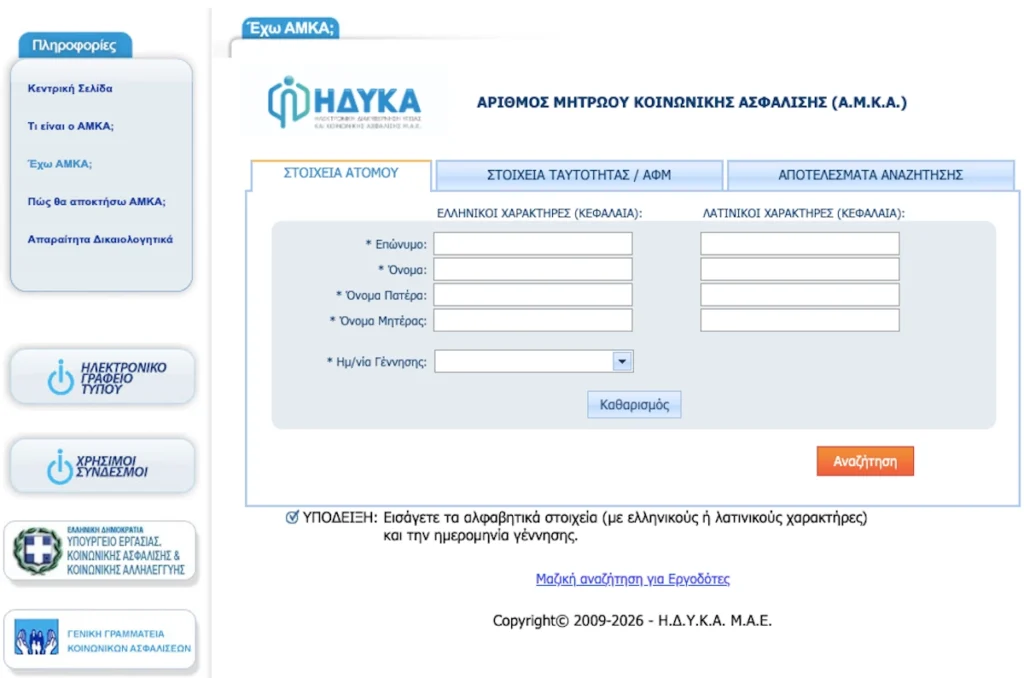
How to Apply: The Right Order of Steps
For foreign nationals, obtaining an AMKA is a crucial step after registering for an AFM Tax Identification Number (Αριθμός Φορολογικού Μητρώου / ΑΦΜ) and establishing residency in Greece. The AFM must come first, you cannot apply for an AMKA without it, and obtaining it requires a visit to your local tax office (Δ.O.Y.) with a valid passport and proof of address. Once your AFM is in hand, appointments can be made at local KEP Citizens’ Service Centres (Κέντρο Εξυπηρέτησης Πολιτών / ΚΕΠ) or at branches of the EFKA Social Insurance Agency (Ενιαίος Φορέας Κοινωνικής Ασφάλισης / ΕΦΚΑ), which is the primary issuing authority. Many expats prefer KEP offices as they are widespread and typically have English-speaking staff, though non-EU citizens are often directed specifically to EFKA branches.
Documents You Will Need
The documents required vary slightly depending on your nationality. All foreign applicants must bring a valid passport along with a photocopy, their AFM, and proof of address in the form of a rental agreement verified on TaxisNet, a utility bill, or a hospitality declaration. Non -EU citizens must additionally present a valid residence permit or a certificate of application, commonly known as the “Blue Receipt”, before they can be issued a full AMKA. While some offices accept walk-ins, booking an appointment in advance is strongly recommended, either by calling the 1555 citizen helpline or through the gov.gr appointment platform if you already have your TaxisNet credentials. Most applicants receive their AMKA on the same day as their submission.
When to Apply
Timing matters when it comes to applying. You should seek your AMKA as soon as you have established residency and obtained your AFM, since it is a mandatory requirement for signing an employment contract, enrolling in school, or accessing the national health system. Whether you are starting work, seeking medical care, or planning long-term residence in Greece, securing your AMKA is the foundational step to participating fully in the country’s social and administrative systems.
SOURCES
AMKA Obligation: Law 3655/2008, Article 153.
Issuance Procedure & Requirements: JMD* Φ80321/οικ.22804/3534/2023 (Gov. Gazette B' 7389/2023) & e-EFKA Circular 15/2024.
* JMD: Κοινή Υπουργική Απόφαση / KYA
***