
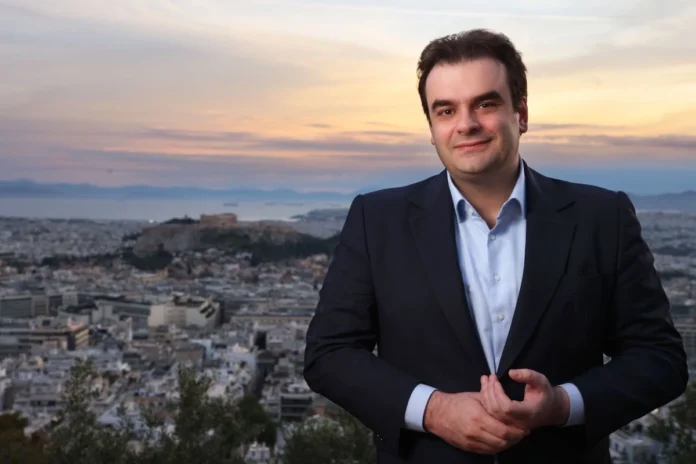
Kyriakos Pierrakakis, Minister of National Economy and Finance and President of the Eurogroup, Explains Why Greece Is Safe for Expats
In this exclusive interview for the Greece Retirement Guide, Kyriakos Pierrakakis discusses debt reduction, banking stability, and the tax framework shaping the country’s appeal to foreign retirees. Trained in technology policy and public administration at MIT and Harvard, Kyriakos Pierrakakis earned a reputation for overhaul-driven reform through the creation of Greece’s digital public platform. His career focus rests on streamlining administrative systems for everyday citizens and relocating expats.
How safe is Greece today as a country for a foreign retiree to settle their life and their savings?
The data gives a clear answer. Greece has regained investment-grade status from all the rating agencies. Public debt is falling at the fastest rate in the European Union for the sixth consecutive year, from 154% of GDP in 2024 to under 140% this year, with a target of dropping below 120% by 2029. We are producing some of the highest primary surpluses in the Eurozone, and in 2026 alone we are repaying nearly €13 billion of debt early, so as not to pass the bill on to the next generation.
This isn’t just a favorable moment. It’s a change of era for the Greek economy, which is becoming more mature, more outward-looking, and more dynamic. We’ve had political stability since 2019, and rules that don’t change every year.
For someone choosing to live here and entrust their savings and their future to Greece, security means a stable currency, a stable state, and stable rules. And today Greece offers all three.
What are the strongest elements of the Greek economy that can give a retiree the certainty they need for long-term financial planning?
The first is fiscal stability. It’s no longer something imposed on us. It’s our own choice, and it has society’s support. Greece has proven it can grow while at the same time putting its public finances in order.
The second is growth. The Greek economy is consistently growing faster than the Eurozone average and, more importantly, it’s changing its production model. Investment is rising at a rate several times the European average, and exports have strengthened significantly. We’re not relying on consumption alone. We’re producing more, investing more, and exporting more.
The third is the banking system. Greek banks now hold investment-grade status, strong capital, and high liquidity. A decade ago, the banks were part of the problem. Today they finance growth and are part of the solution.
And the fourth is the state. Its digitalization isn’t just a convenience in daily life. It means less bureaucracy, more transparency, and greater predictability. And predictability is perhaps the most important thing a country can offer someone planning to spend the next twenty years of their life here.
As President of the Eurogroup, how do you see the economic stability of the Eurozone over the coming years, and what does that mean for someone who chooses to live in Greece and use the euro?
The Eurozone has already passed its toughest stress test. Within a few years it faced a pandemic, an energy crisis, a war on its borders, and a powerful wave of inflation. And it held up. The euro remained strong, inflation returned to controlled levels, and public finances went back on a path of consolidation. The Eurozone’s resilience is no longer a promise. It has been tested in practice.
Now we need to take the next step. At the Eurogroup, we’re working on the Savings and Investments Union — that is, completing the Capital Markets Union and the Banking Union. At the same time, we’re working on the digital euro.
For someone living in Greece, all of this has practical significance. Their savings sit in a strong common currency, with an independent central bank whose clear mandate is price stability. There’s no exchange-rate risk and no convertibility risk. The euro in Athens is the same euro as in Frankfurt.
The cost of living, and especially housing costs, has risen. How can Greece maintain its appeal for retirees with a stable but not high income?
I won’t sugarcoat it. Housing prices have gone up, especially in Athens and in certain island destinations. It’s partly the price of progress: when a country becomes attractive again, demand outpaces supply.
Our answer is supply. Incentives to bring closed properties back onto the long-term rental market, support for first homes, faster urban-planning procedures. Housing is one of the core priorities of our economic policy for the period ahead — and not only for foreigners. Greeks come first.
I’d add something about geography, too. Greece isn’t just two or three destinations. The Peloponnese, Crete, Epirus, Halkidiki, dozens of islands offer excellent quality of life at a cost noticeably lower than comparable areas of Italy, Spain, or Portugal. And housing is just one part of the budget. Healthcare, food, energy, daily life remain affordable compared to Northern Europe.
What is today the greatest economic threat to the purchasing power of a retiree in Greece: inflation, housing costs, or something else?
Inflation was the challenge of 2022 and 2023. Today it’s easing and moving close to the Eurozone average. Housing cost is today’s challenge, and I’ve already described how we’re addressing it.
But if you’re asking me what the greatest threat to purchasing power is, I’d say it’s uncertainty. A retiree isn’t as afraid of a 3% price increase as they are of not knowing what the rules will be in five years. That’s why the best protection for their purchasing power isn’t any single measure. It’s the stability of the framework: stable taxation, stable currency, stable institutions. Our compass doesn’t change, and that’s what has value over time.
Greece offers a special tax regime for certain new tax residents from abroad. Do you believe today’s framework is competitive and stable enough for a retiree to base long-term planning on it?
The regime for foreign retirees who transfer their tax residence to Greece is a flat 7% rate on foreign-source income, for fifteen years. One declaration, one rate, one payment. It’s among the most competitive in Europe, and its simplicity is its greatest advantage.
As for stability, the framework was legislated with an explicit fifteen-year horizon specifically to provide the certainty you’re describing. Whoever enrolls, enrolls under known terms for the entire duration. And Greece has every reason to honor that commitment. The people who come to live here, to spend here, to put down roots here, are exactly the kind of trust we want to attract.
What would you want a foreign retiree to know before buying property in Greece, given the sharp rise in prices in recent years?
Three things.
First, the rise started from a very low base. Property prices fell more than 40% during the crisis and, in many areas, still haven’t returned to 2008 levels in real terms. We’re talking about a recovery after a massive drop, not overheating.
Second, the market today is far more transparent and secure. The Land Registry is nearing completion, transfers are done digitally, and the electronic building identity is mandatory. The uncertainty over “what a property might be hiding” has been significantly reduced. And of course, before any purchase, a check by a lawyer and an engineer remains essential.
And third, the Greek property market isn’t limited to two or three expensive, high-profile destinations. Greece still has many areas with real value and significant potential. Anyone who looks beyond the obvious can find opportunities. And of course, buying isn’t the only path. One can simply rent a home and live in Greece until deciding they want to settle permanently in the country.
How safe do you consider the Greek banking system today for someone who wants to transfer part or all of their savings here?
The Greek banking system of 2026 bears no resemblance to that of 2015. The systemic banks hold investment-grade status. Non-performing loans have fallen from almost 50% to 3%. Deposits far exceed loans, and supervision is carried out directly by the European Central Bank, under the same rules that apply to every major European bank.
For depositors, the same rules apply as across the whole Eurozone: deposit guarantees up to €100,000 per depositor per bank, uniform rules, uniform supervision. The capital controls some people remember from 2015 were fully lifted years ago.
And one more thing that speaks volumes: Greek banks today are expanding abroad, making acquisitions, distributing dividends. Those aren’t the moves of a system in weakness. They’re the moves of a system that has rediscovered its confidence.
For a retiree who doesn’t speak Greek, how easy is it today to deal with the Greek tax administration? Is there progress in providing basic services, guidance, and digital procedures in other European languages?
There’s progress, and there’s still a way to go. I’ll be honest about both.
The progress is real. AADE [the Greek tax authority] is today one of the most digitalized tax authorities in Europe. Tax ID issuance, income tax filing, payments, and certificates are all done electronically. There is English-language content for the core procedures, and dedicated services for residents living abroad.
The way still to go is reaching a single, fully multilingual point of contact for every new tax resident, from enrollment in the special regime through to the annual tax return. I consider this important, because the first contact with the state shapes the image of the country. Until we get there, of course, the help of a good accountant is invaluable — and in Greece we have many.

Many foreign retirees continue to receive a pension or hold assets in their country of origin. How simple is the financial life today of someone who lives in Greece but has income and assets in more than one country?
Simpler than most people imagine, for two reasons.
The first is the special regime itself. The flat 7% rate covers all foreign-source income — pension, rental income, dividends, interest — with no distinction by category. It’s about as simple as a tax system can get.
The second is the international framework. Greece has double-taxation treaties with more than fifty countries, including all EU member states, the UK, the US, and Canada. The exchange of information between tax authorities is now automatic, which means transparency for everyone and less bureaucracy for the compliant taxpayer.
My practical advice: one meeting, at the start, with an advisor who understands both sides. After that, financial life becomes routine.
Greece has been through a very difficult economic period and today finds itself in a very different position in European economic discussions. What is the most important lesson from that period that someone planning their retirement in Greece today should know?
No country in Europe paid as dearly for fiscal laxity as Greece did. And perhaps in no other country is the conviction so strong today that we must never go back there. The surpluses, the debt reduction, the early repayments — none of it is imposed on us anymore by anyone. These are our own choices, and society supports them, because it remembers what the opposite cost.
But there’s also something with powerful symbolism. Today, as President of the Eurogroup, I represent a country that a decade ago was constantly at the center of its meetings for the wrong reasons. Greece went from crisis to credibility, and from being under supervision to being an equal participant in European decisions.
That journey has value beyond the numbers. It shows that Greece was tested, changed, and won back trust. And for someone planning to spend the coming years of their life here, that may be the most important thing of all. They’re choosing a country that has already been through the great trial — and came out stronger.
If a foreign retiree asked you for just one piece of advice before deciding to move their permanent residence to Greece, what would it be?
Come, without a second thought.
The tax framework is competitive, the currency is safe, the banks are healthy. All of that matters, which is why we discussed it in detail. But the success of an economy is judged in people’s lives, not in indicators. No one remembers the best years of their life because of a good tax rate. They remember them for the light, the sea, the people around them, a daily life with meaning. That’s what Greece offers. The economy simply makes it safe now to choose it.
My advice would be to live through a winter here first, not just a summer. They’ll understand that even in February, Greece is a wonderful country.
ABOUT THE EXPERT
Kyriakos Pierrakakis
Minister of National Economy and Finance, President of the Eurogroup
Elected to the Hellenic Parliament in 2023 (next national elections: 2027), Kyriakos Pierrakakis has served as a minister across three portfolios since 2019, currently as Minister for the National Economy and Finance since March 2025. He was elected President of the Eurogroup by his eurozone counterparts in December 2025, for a two-and-a-half-year term.
Ministry of National Economy and Finance
ministeroffice@minfin.gr
***
For All the Practical Information in One Place
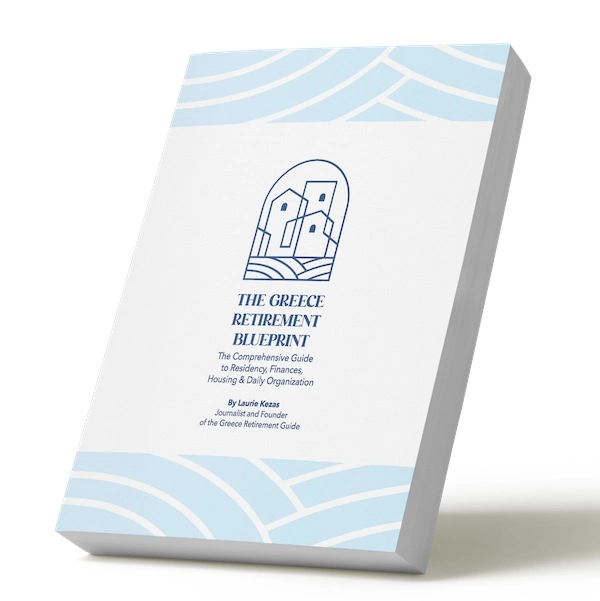
If you want all the essential administrative details gathered in a single document, the 104-page Greece Retirement Blueprint covers taxation, healthcare registration, housing logistics, banking, driving regulations, and everyday life in Greece.