

Rural and Surveying Engineer Explains the Uncertainty Facing Thousands of Greek Landowners
For the past three years, thousands of owners of rural plots (agrotemachia) have found themselves facing an unprecedented situation, and the question they put to engineers, notaries, and lawyers every day is a simple one: can they build on their land or not. In June 2026, Greece ratified its new Spatial and Urban Planning Code, known as the “Nikolaos Tagaras” Code, which brought the country’s scattered planning legislation together under a single text. For rural landowners, though, the Code did not settle the one question that matters most to them: whether their plot has legal access to a recognized road. Below, a Rural and Surveying Engineer who runs a technical office in Volos explains what has actually changed, what hasn’t, and what owners of rural plots need to know while the transition plays out.
By Grammati Baklatzi, Rural and Surveying Engineer
The answer is not the same throughout Greece. Some Building Permit Services (Υπηρεσίες Δόμησης, known as YDOM) issue permits, others require additional opinions, while still others believe that, following the case law of the Council of State, they cannot proceed without a legally recognized public road. The result is that two citizens with nearly identical properties are treated differently, depending on the area where their property is located.
The State has chosen to address the problem definitively through Local Urban Plans (Τοπικά Πολεοδομικά Σχέδια), the recognition of the public road network, and new Presidential Decrees. This is a necessary reform. However, it requires at least three years for approval, and until it is completed, the country finds itself in a prolonged transitional stage, without uniform rules of application. The question now is not whether the system of out-of-plan building needs to change, but whether the State can leave citizens in a state of uncertainty for another three years or more, without clear and uniform rules.
Whether You Can Build Today Depends on More Than It Used To
The answer now depends on far more factors than in the past. It is no longer enough for the plot to have an area of 4,000 sq.m. or to meet the conditions for exceptions (parekliseis) where these still apply. The case law of the Council of State has brought back to the forefront the issue of access to a legally recognized public road, which has led many Building Permit Services to adopt different interpretations. In simple terms, there is currently no single uniform practice across the country.
The Uncertainty Traces Back to a 2023 Council of State Ruling
The starting point was the case law of the Council of State, and in particular Decision 176/2023, which ruled that for building outside the urban plan, the actual physical existence of a road is not sufficient; the road must also have institutional recognition under urban planning legislation. This development changed the way many Building Permit Services handle applications for building permits.
The paradox is that for decades the State itself considered many of these plots buildable, issued building permits, collected taxes, and allowed transfers to take place under the framework in force at the time. Today, however, the same reality is being re-examined under stricter institutional criteria. And this would be entirely legitimate if a clear transitional framework existed at the same time. Without one, legal uncertainty is created.
Building Services Apply Different Rules Because No Uniform Law Exists Yet
There is not yet a single legislative provision regulating the transitional period in a uniform way. Building Permit Services are trying to apply the case law of the Council of State, even though the tool that will determine which roads are considered public for urban planning purposes has not yet been completed.
This creates different administrative practice from area to area, which undermines legal certainty. The same urban planning issue cannot have a different answer depending on the municipality, the service, or the locally followed interpretation.
A Transitional Solution Was Proposed, But Never Passed
The Ministry of Environment and Energy (ΥΠΕΝ) had drafted a transitional legislative regulation, which was ultimately not submitted to Parliament. According to that draft, until the Presidential Decree recognizing public roads was issued, building permits could be issued for plots of at least 4,000 sq.m., provided the access road met a strict set of conditions: it had to have existed before 27 July 1977, have a minimum width of 3.50 metres, and connect to a provincial or municipal road, while the plot itself had to carry a KAEK (property identification number) in the Land Registry under the special designation “EK.” It would also need to be established whether road works had been carried out by the Municipality or Region, and whether utility networks were already in place. For older plots, the possibility of making use of a legal right-of-way easement was also envisaged, under conditions.
The proposed regulation did not abolish the restrictions imposed by the case law. On the contrary, it set specific technical and environmental criteria.
The Government Chose a Permanent Fix Over a Temporary One
The government judged that a temporary solution should not be given, and that the issue should instead be resolved definitively through the Local Urban Plans and the recognition of public roads. This choice has a certain logic: instead of a temporary fix, the aim is a definitive resolution of the problem through comprehensive spatial and urban planning.
The critical question, however, is what happens until this process is completed. The completion of the Local Urban Plans is not immediate. It requires environmental assessment, official opinions, review by the Council of State, and final issuance of a Presidential Decree. Similarly, the recognition of public roads requires recording, verification, institutional assessment, and ratification of the road network.
Local Urban Plans Will Set the Final Rules for Land Use and Building
The Local Urban Plans will definitively determine land uses, development zones, building terms, protected areas, and the compatibility of each type of activity. However, for them to take effect, a particularly complex process is required, including environmental licensing, official opinions, review by the Council of State, and final issuance of a Presidential Decree. The first approvals are expected gradually, while full implementation will take longer.
New Settlement Boundaries Will Redraw Who Can Build and Who Cannot
The new settlement (oikismos) boundaries will significantly affect buildability, because many properties currently considered to be within a settlement may end up outside the new boundaries. Plots that remain within the new boundaries generally retain the ability to build under the settlement’s terms. Those that fall outside, or into outer zones, will be assessed under stricter criteria, such as minimum plot requirements, frontage on a public road, and special restrictions. For many small plots, this could in practice mean the loss of the ability to build.
Public Roads Still Need Official Recognition Before They Confer Building Rights
The road-recording studies have been submitted, but their submission does not mean the roads have automatically been recognized as public. The next critical step is for the Ministry of Environment and Energy to issue the Presidential Decree establishing uniform criteria for road recognition, and then to ratify the public road network. Roads will be evaluated using specific historical and technical criteria, including old aerial photographs, cartographic data, Land Registry records, and similar sources, and only those that meet the conditions will be able to confer buildability on adjoining properties. Until this process is complete, uncertainty remains.
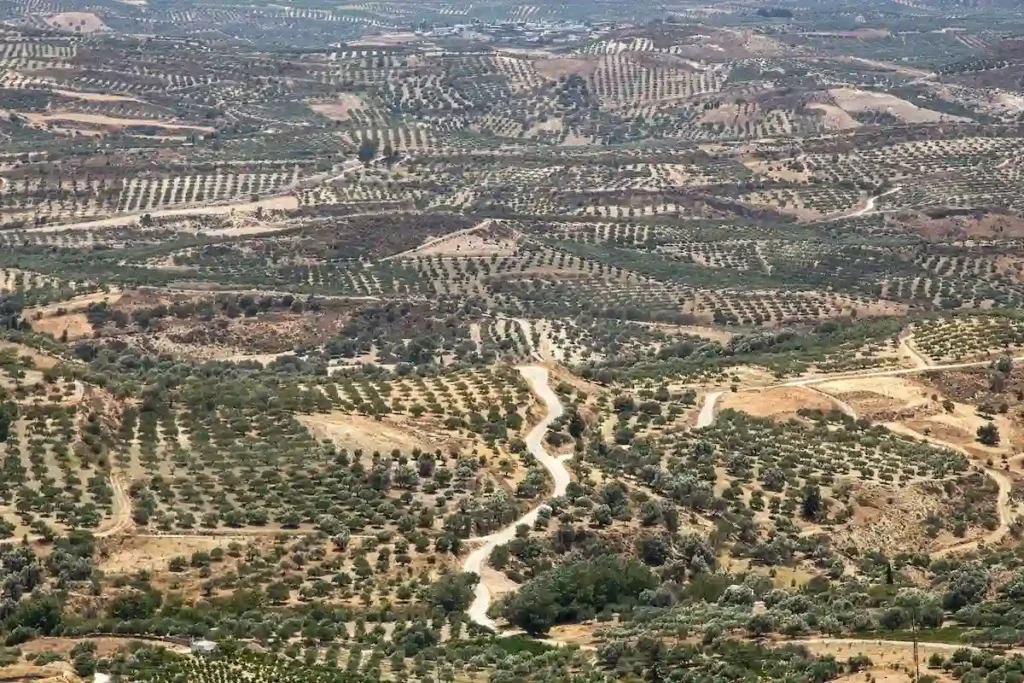
An Unrecognized Road Can Cost a Plot Its Right to Build
If a road is not recognized, the property will not be considered to have legal frontage on a public road. Therefore, even if it meets the required square-meter thresholds, it may not be possible to build on it, unless there is another legal form of access or a special regulation applies.
This issue is particularly serious, because it concerns roads that in many cases have been in use for decades, have served homes and business activities, have utility networks running along them, or have been maintained by public authorities. The State has a duty to provide clear rules for how these cases will be handled during the transitional period.
Rights-of-Way on the Islands Guarantee Access, Not Necessarily Building Rights
Rights-of-way (douleies diodou) will remain valid as an access right, but they will not always be sufficient to establish buildability. In out-of-plan building, the decisive factor is not merely whether someone can reach their property, but whether the plot has frontage on a legally recognized public road. Therefore, in many cases — mainly on the islands, where old passages, footpaths, or private access routes exist, it will need to be examined whether that access can be recognized for urban planning purposes. If it is not recognized, the right-of-way may secure access, but not necessarily the right to build.
A Transitional Law Is Still Needed to Bridge the Gap
The answer is yes: a transitional legislative regulation is still needed. Not in order to bypass the case law of the Council of State, nor to overturn the new urban planning framework, but in order to have uniform rules until the planning process is complete.
The transitional regulation could be based on the proposals already drafted by the Ministry, incorporate the requirements set by the case law, provide for strict technical criteria and robust environmental safeguards, and be applied uniformly across the country. Environmental protection and modern urban planning are not at odds with legal certainty. On the contrary, the success of the reform depends on citizens knowing clearly which rules apply today and which will apply tomorrow.
A transitional legislative regulation is not a retreat from the new planning framework. It is the institutional bridge that will allow the country to move safely from the old to the new urban planning regime, while at the same time protecting the environment, property rights, and citizens’ trust in the rule of law.
Purchasing Property in Border Areas
If you want to learn more about real estate transfers near national borders or island frontiers, review the mandatory legal background check and security clearance process required before acquiring title to property in these sensitive zones.
ABOUT THE EXPERT
Grammati Baklatzi
Rural and Surveying Engineer (Αγρονόμος και Τοπογράφος Μηχανικός)
Member of the Technical Chamber of Greece (TEE): 58519
89 Gazi Anthimou, Metamorfosi, 383 33 Volos, Magnisia, Greece
baklatsi@yahoo.gr
SOURCES
New Spatial and Urban Planning Code: Law 5306/2026, "Nikolaos Tagaras" Code (Government Gazette A΄88/08.06.2026). Road Recognition Requirement: Council of State, Decision 176/2023.
***