
The Herd That Stayed Behind on Kefalonia’s Mountain
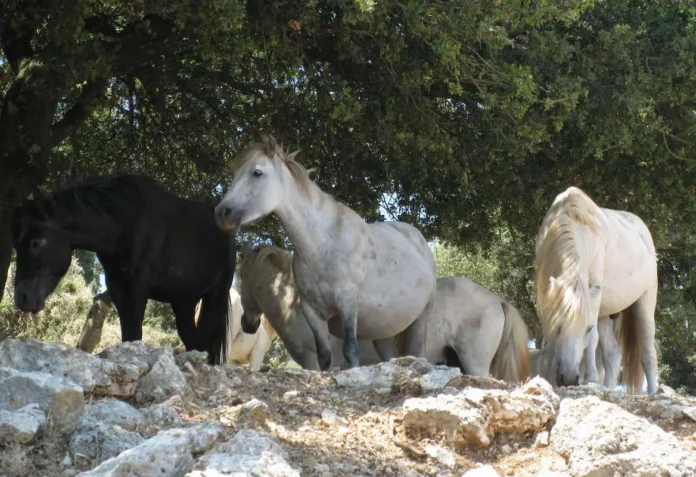
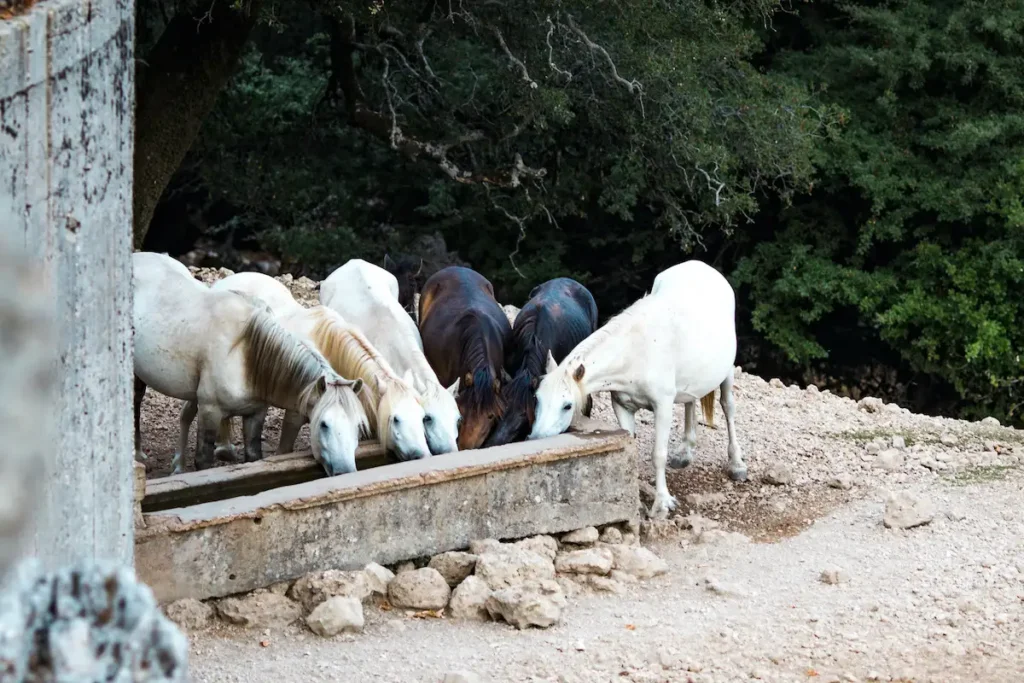
High on the south-southeastern slopes of Mount Enos on the island of Kefalonia, a small herd of semi-wild horses lives in one of the most dramatic landscapes of the Ionian Islands. They roam within the wider area of Enos National Park, close to the Zoodochos Pigi Monastery, where the mountain’s only reliable freshwater spring serves as a gathering point for the horses, for sheep, goats, and the shepherds who move through the area.
These horses are not truly wild in origin, but they have lived free for so long that they now belong to the mountain as much as the fir trees and limestone ridges. Today, only one herd remains, and their numbers have declined so sharply that they are considered under threat of extinction.
How the Horses Came to Live on Mount Enos
The presence of horses on Mount Enos is rooted in an old rural custom. For generations, peasants in parts of Greece allowed their horses to roam freely in the mountains rather than keep them year-round in stables. The animals grazed on their own, and when needed, they could be gathered again. Over time, especially after the Second World War, many of these horses were simply left behind as agriculture changed and machines replaced animal labour.
Small groups survived in isolation high on the mountain. Over decades, harsh winters, summer drought, and the absence of veterinary care reduced their numbers. The herd that survives today is believed to descend from those domestic animals, shaped by natural selection in an environment that offers little shelter, limited food, and scarce water.
Life in a Harsh Landscape
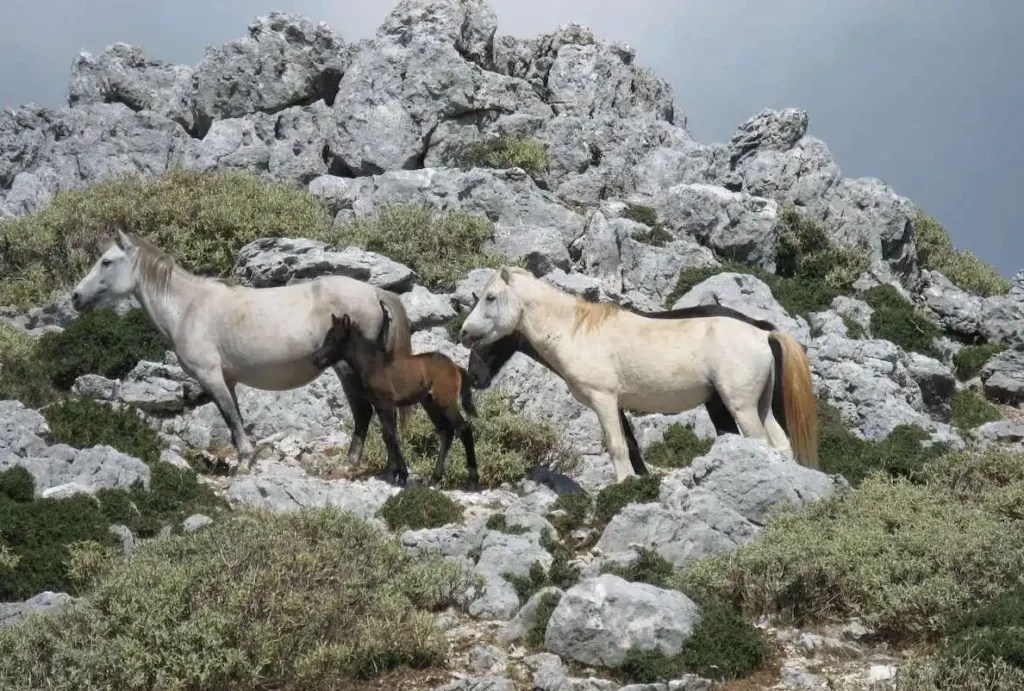
Life on Mount Enos is demanding. At high altitude, winter brings cold winds and occasional snow, while summer dries the ground and reduces vegetation to sparse patches. Natural shelter is limited, and food can be scarce for long periods. The herd’s survival depends on the spring near the monastery, the most precious resource.
Because of this, wildlife sightings often happen near the reservoir where the horses come to drink, particularly toward evening when the heat of the day fades. Even then, there is no certainty. The mountain is vast, and the herd moves freely across it, following the rhythms of weather, pasture, and instinct. There are no houses nearby and there will not be, as real estate agents frequently explain to prospective investors that strict conservation rules prohibit any new constructions on the mountain.
How the Enos Horses Look
The Enos horses are generally small to medium in size, with powerful legs, tough hooves, and dense manes that help them endure exposure to wind and cold. Their coats are most often dark, in shades of brown, bay, or black, and their movements on steep, rocky ground reveal a remarkable agility.
Although they are accustomed to the sight of people, they are no longer tame. When approached too closely, they move away quietly, keeping a careful distance. Their behaviour reflects animals that have learned to live without depending on humans but still remember their presence.
When and How They Can Be Seen
Finding the Enos horses requires patience and a measure of luck. Mount Enos is large, and the herd does not remain in one place. Visitors who hope to see them often head toward the area around the monastery in the late afternoon or early evening, when the light softens and animals begin to move toward water.
Reaching this part of the mountain can be an experience in itself. The road winds upward from the southern side of the island, sometimes paved and sometimes rough, passing isolated farms and tiny settlements. At a certain point, many travelers choose to leave their car and continue on foot, both because of the condition of the road and because walking allows the mountain to reveal itself more slowly.
Even locating the monastery can be unexpectedly difficult. Several monasteries in Greece share the same name, and online maps do not always indicate the one on Mount Enos clearly. Some visitors discover its location only after careful searching or by following coordinates shared by others who have encountered the horses there.
Waiting is often part of the experience. The mountain grows quiet, the light changes, and the landscape begins to cool. Sometimes nothing happens, and sometimes, almost silently, shapes appear in the distance, and the herd emerges, moving across the slope before disappearing again into the vastness of the mountain.
A Fragile Future
The future of the Enos horses remains uncertain. With only one herd left, their population is vulnerable to environmental pressures and the limits of a small gene pool. Awareness of their situation has grown in the last years, yet their survival is still far from guaranteed.
To encounter them is not simply to see wildlife. It is to witness endurance, adaptation, and the long, quiet persistence of life in a place where survival has never been easy.
Explore our comprehensive guide to living in Kefalonia, an island that famously provided the inspiration for Louis de Bernières’ Captain Corelli’s Mandolin.
The return on the island is seen through the lens of a dual-nationality retiree, who shares the reality of moving beyond the cinematic backdrop to build a genuine life. Together, these perspectives offer a sophisticated roadmap for those looking to trade the book’s fiction for the island’s authentic, year-round rhythms.
***