
Residing Within an Unbroken Historical Fabric
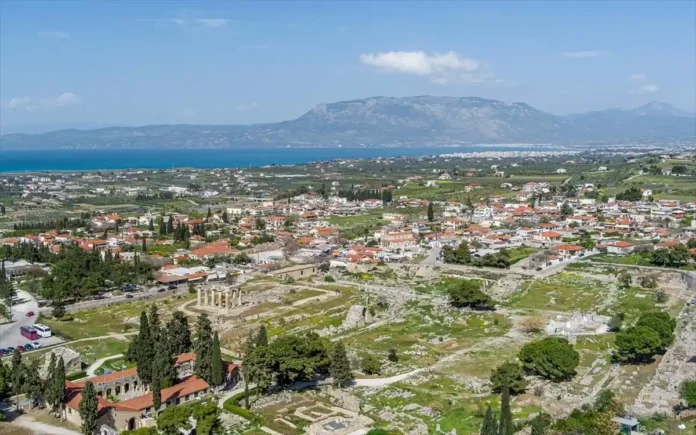
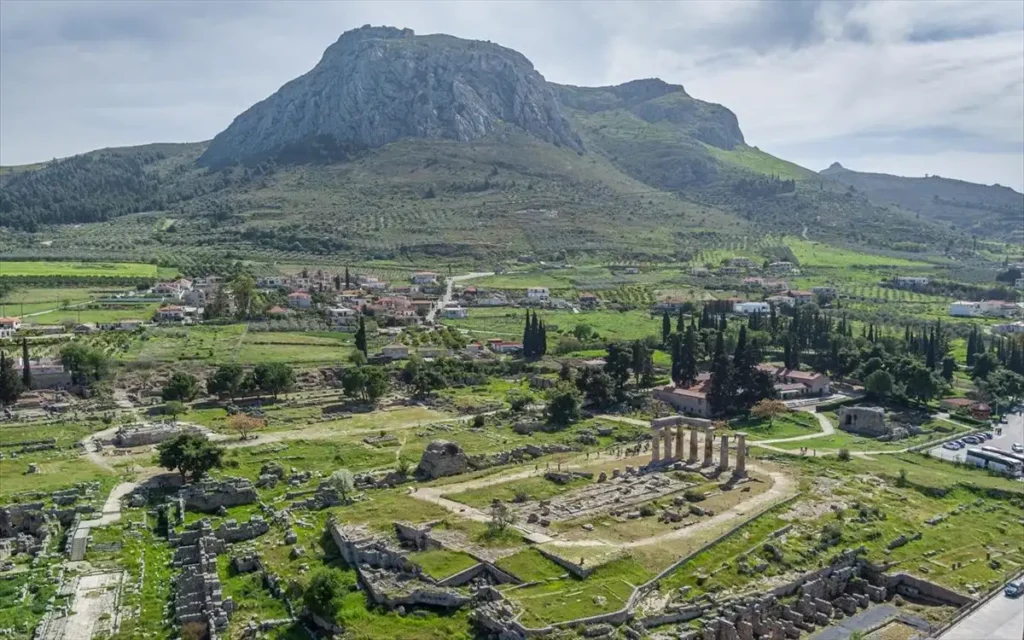
In many parts of Greece, an acropolis is a distant silhouette. In Ancient Corinth (Archaia Korinthos), it is an overwhelming physical presence. The limestone massif of Akrokorinthos rises 575 metres directly above the village—a vertical fortress that has dictated the defensive and psychological terms of this landscape since the Neolithic age. To live here is to reside at the intersection of two empires. You walk past the monolithic Doric columns of the Temple of Apollo, only to cross a street paved by Roman engineers. The ancient world here is not an elective excursion; it is the geography of your kitchen window.
The modern village is a settlement with the rare privilege of being fully integrated into a landscape of global significance. It is not a “dead” archaeological destination, but a vibrant community where modern houses surround the historic zone. Residents enjoy a daily life where a morning coffee is accompanied by views of 6th-century BC columns and the soaring walls of the fortress.
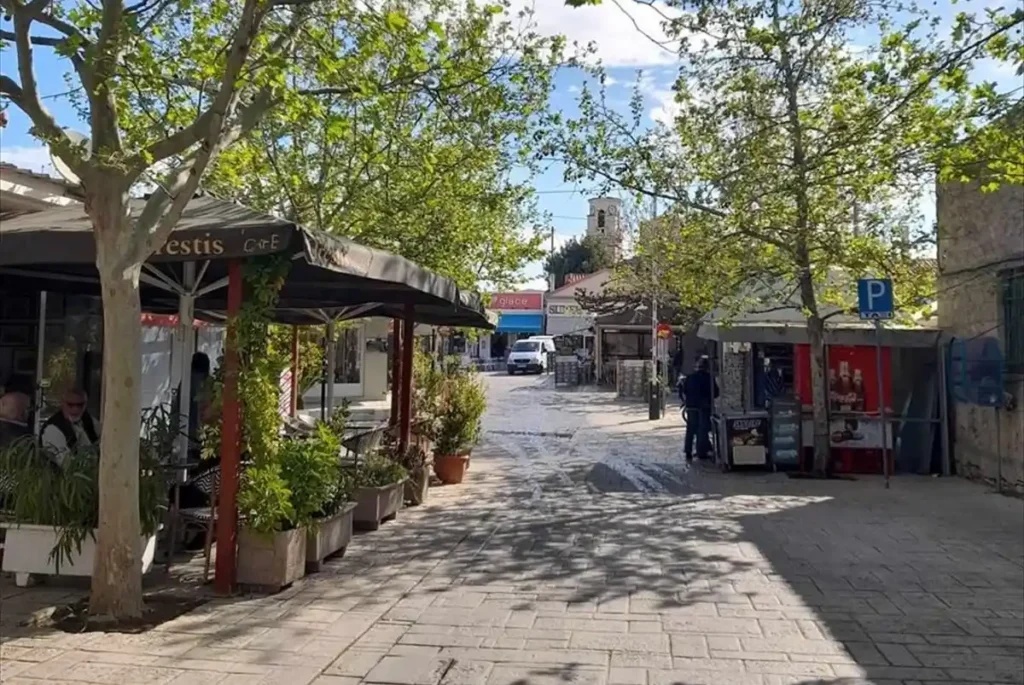
The village is built directly atop the vestiges of one of the wealthiest cities of the classical and Roman Mediterranean. This is the city of the Isthmian Games, of St. Paul’s letters, and of the Roman forum. Today, the relationship between the local community and the Archaeological Service is one of constant, regulated negotiation. Much like the rigorous protections found in the historic settlement of Lindos, the village is a protected zone. Modern life is shoehorned into a grid where any deep excavation for a cellar or a pool is likely to uncover a mosaic floor or a Roman drainage pipe.
The Landmarks of the Landscape
To understand the area as a resident, one must view it in three distinct levels:
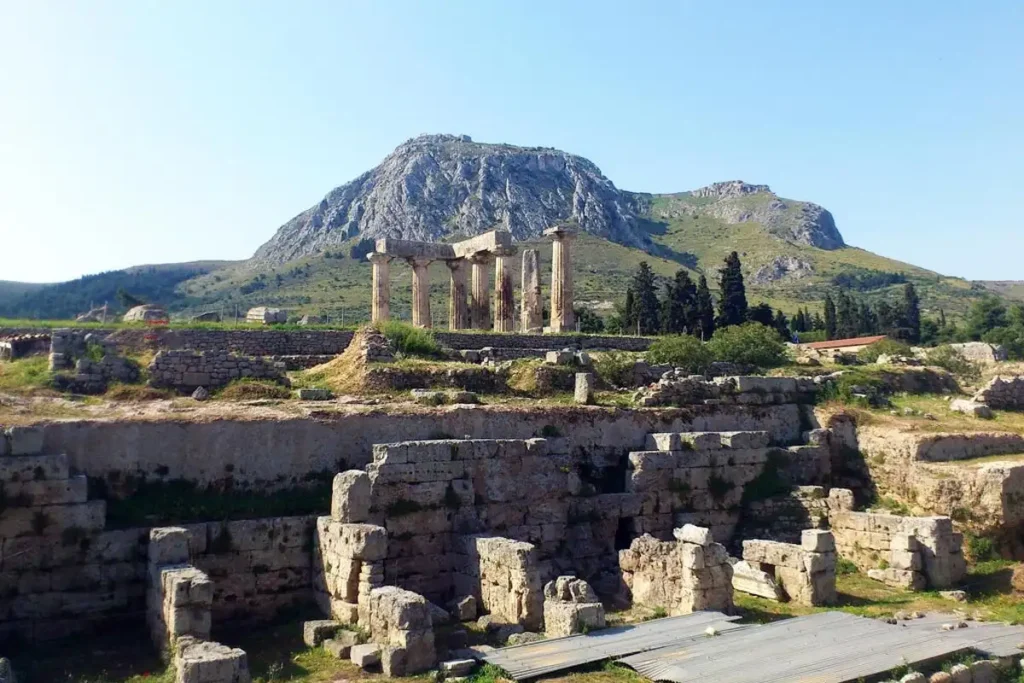
The Temple of Apollo
Standing directly north of the Ancient Agora, this is the city’s primary landmark. Built around 540 BC, its monolithic columns are the first thing you see when entering the village. It serves as the visual anchor connecting the residential areas to the ruins.
The Archaeological Core
This includes the Roman Forum, the Vima (the historic stone platform where Roman leaders addressed the public), and the Peirene Fountain, which has supplied the city with water for millennia.
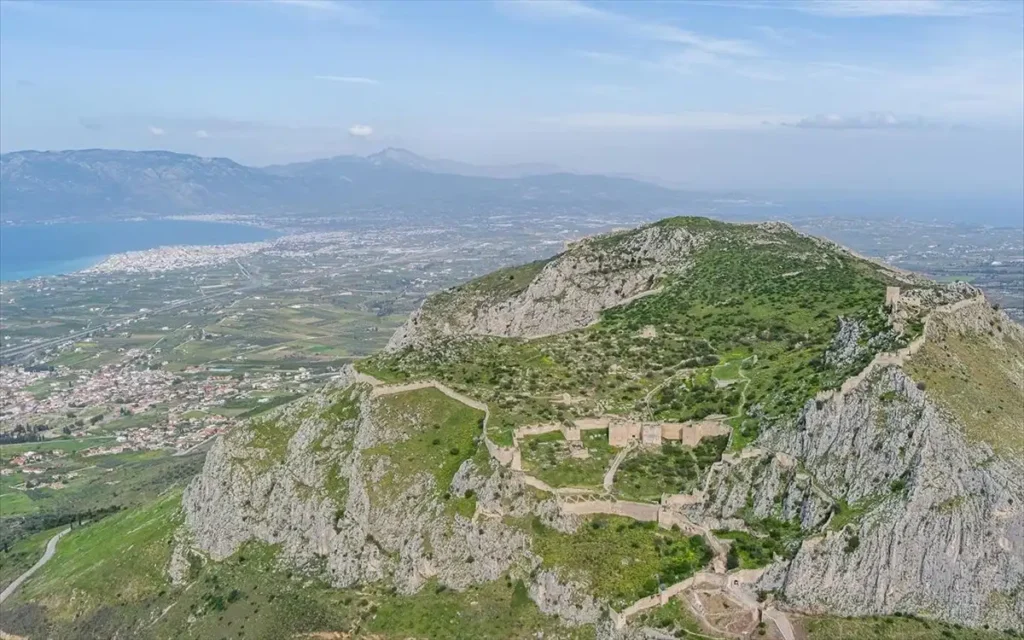
Akrokorinthos
The precipitous rock rising above the town served as the fortified acropolis and the “eye” of the Peloponnese. Within its 3-kilometre-long walls, traces of Byzantine, Venetian, and Ottoman history coexist.
A Worldly Community in a Local Setting
Unlike Mavromati, which remains a quiet agricultural retreat, Ancient Corinth has a more vigorous, dual-natured rhythm. Its proximity to Athens and the Corinth Canal attracts a steady stream of global visitors, yet it remains a functioning Greek village.
The “foreign” element here is deep-rooted. Since the late 19th century, the American School of Classical Studies has maintained a permanent presence. This has fostered a unique social environment where world-class researchers and local families have shared the same kafeneio for generations. The result is a community that is worldly yet deeply local, where the “non-evident angle” of a news story is likely to be debated with historical context rarely found elsewhere.
Infrastructure, Climate, and Connectivity
The Corinthia region is known for its productivity and balance. Protected by the surrounding mountains but open to the Gulf of Corinth, the village enjoys a Mediterranean climate slightly more temperate than the Attic plain. The surrounding plains are the kingdom of the “Black Gold”—the Corinthian currant—alongside extensive citrus and olive orchards.
This is perhaps the most accessible “ruin-side” lifestyle in Greece. Athens is a mere 80 kilometres away, reachable in an hour via the modern motorway or the suburban railway. Furthermore, the General Hospital of Corinth is just 7 kilometres away, providing a level of medical security that more remote villages cannot always offer.
The Economics of a 3,000-Year-Old Address
Property in Ancient Corinth is a study in scarcity. Because much of the surrounding land is “locked” by archaeological restrictions, new construction is nearly non-existent. Detached stone houses within the village core are highly sought after. Prices typically begin at €280,000 for a property requiring renovation, reaching upwards of €700,000 for villas with unobstructed views of the Temple of Apollo or the Akrokorinthos.
Ancient Corinth commands a significant premium over the nearby modern city. Investors and retirees are paying for the “Archaia” prefix—the guarantee of an unspoilable view and a 3,000-year-old pedigree. For the retiree who requires intellectual stimulation and logistical convenience, Ancient Corinth offers a life of sophisticated proximity at the very center of Greece’s historical axis.
***
By visiting our collection of villages located near archaeological sites, you can weigh the distinct advantages of various regions. Having these comparative insights ensures your final choice is both informed and deeply personal.
Explore the regional property landscape by reading our interview with a local realtor for professional insights on the Corinthian market.