

The siesta is a legal right in Greece. It is also the fastest way to feel at home.
There is a good chance that the afternoon siesta becomes one of your favorite things about living in Greece. Not immediately — it takes a few days to stop feeling guilty about closing the shutters at three in the afternoon — but once you surrender to it, the whole day reorganizes itself around you in the most agreeable way imaginable. You should know there is a law to protect your peace and quiet for your nap. The law did not invent the siesta. It codified something Greeks had been doing long before anyone thought to regulate it. The afternoon rest is a genuine cultural institution, shaped by centuries of living in a climate that turns punishing between roughly two and six in the afternoon.
In high summer, stepping outside between three and five is an exercise in poor judgment. Temperatures regularly exceed 35°C across the mainland and islands, and the sun at that hour has a quality that discourages even the most determined sightseer. The Greeks long ago decided that the response was to get horizontal and wait it out. On the street below a taverna terrace in Athens or along a busy waterfront in Rhodes, life continues — coffees are ordered, conversations run long. But in residential neighborhoods and rural areas the power tools have gone quiet, the television is turned down, and anyone with any sense has drawn the shutters.
Arriving from a place where the midday rest is considered vaguely decadent, you may need a genuine attitude adjustment. The siesta is not laziness dressed up in local color. It is a rational adaptation to the environment, and it reshapes the entire rhythm of the day in ways that reward those willing to follow it.
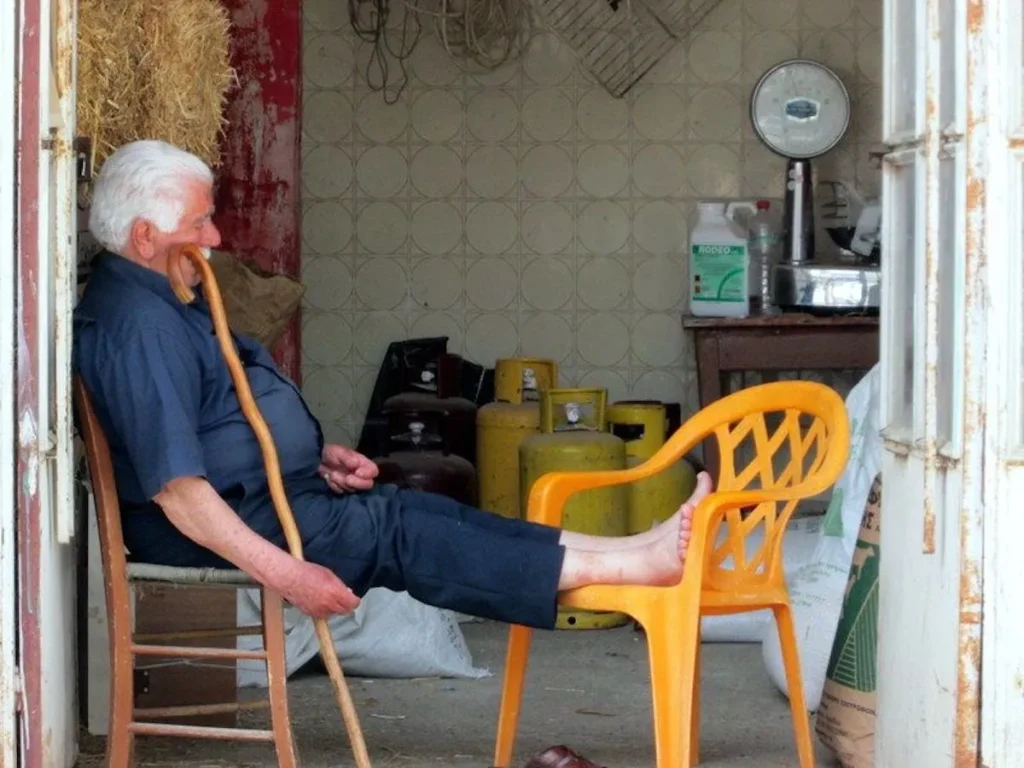
The Law That Protects Your Nap
Police Order No. 3 of 1996 — formally titled “Measures for Public Peace” — governs noise restrictions across the country. Its Article 1 prohibits, during designated quiet periods, any noisy work in residential areas, loud music or television audible to neighbors, and disruptive gatherings in homes, yards, balconies, streets, or public squares. Violations fall under Article 12 of Law 1481/1984 and can technically result in fines or, in the most extreme cases, a prison sentence — though in practice, nobody is being handcuffed for running a vacuum cleaner at four in the afternoon. What the law does is give neighbors and police a clear, unambiguous framework. It signals that the afternoon rest is not a personal preference to be negotiated — it is a shared social contract with official backing.
The schedule shifts with the seasons. From April 1 through September 30, afternoon quiet runs from 3:00 to 5:30 PM and nighttime quiet from 11:00 PM to 7:00 AM. From October 1 through March 31, the afternoon window shifts to 3:30–5:30 PM, with nights quieting from 10:00 PM to 7:30 AM.
The rules apply to residential zones. A beachfront club in a tourist resort operates in a different context, but the quiet neighborhood directly behind it is fully covered. Proximity to nightlife does not create an exemption.
The Logic of the Long Day
What the afternoon rest makes possible is the evening. This is the part of the equation that you may not fully appreciate until you have lived through your first Greek summer. If you sleep at three, you wake refreshed at five or six. The heat is beginning to ease. The streets come back to life. There is time for a walk, errands, a coffee, a conversation. Dinner does not begin until nine at the earliest, and this is not an affectation or a restaurant industry quirk — it is the natural consequence of a day that paused and restarted in the afternoon.
By ten, the taverna is full. By midnight, the table is still occupied. Drinks and conversation at a bar stretch comfortably past one in the morning, often past two. Nobody is watching the clock. The temperature is genuinely pleasant. The urgency that defines evenings elsewhere — eat quickly, the kitchen closes at ten — simply does not exist. The night has time.
This rhythm is, for many retirees, one of the most immediately pleasurable aspects of life in Greece. The pressure lifts. The day has a shape that accommodates both rest and pleasure, both the heat and the cool, in a way that feels quietly sensible once you stop resisting it.
Under Greek law, official afternoon quiet hours change by season. Image credit: Gemini AI.
Making the Adjustment
Of all the adjustments required by relocating to Greece — the language, the bureaucracy, the administrative complexity of settling somewhere new — the siesta is perhaps the most immediately achievable. It costs nothing, requires no documents, and carries no waiting period. It is, in the most literal sense, the easiest way to begin living like a Greek.
***